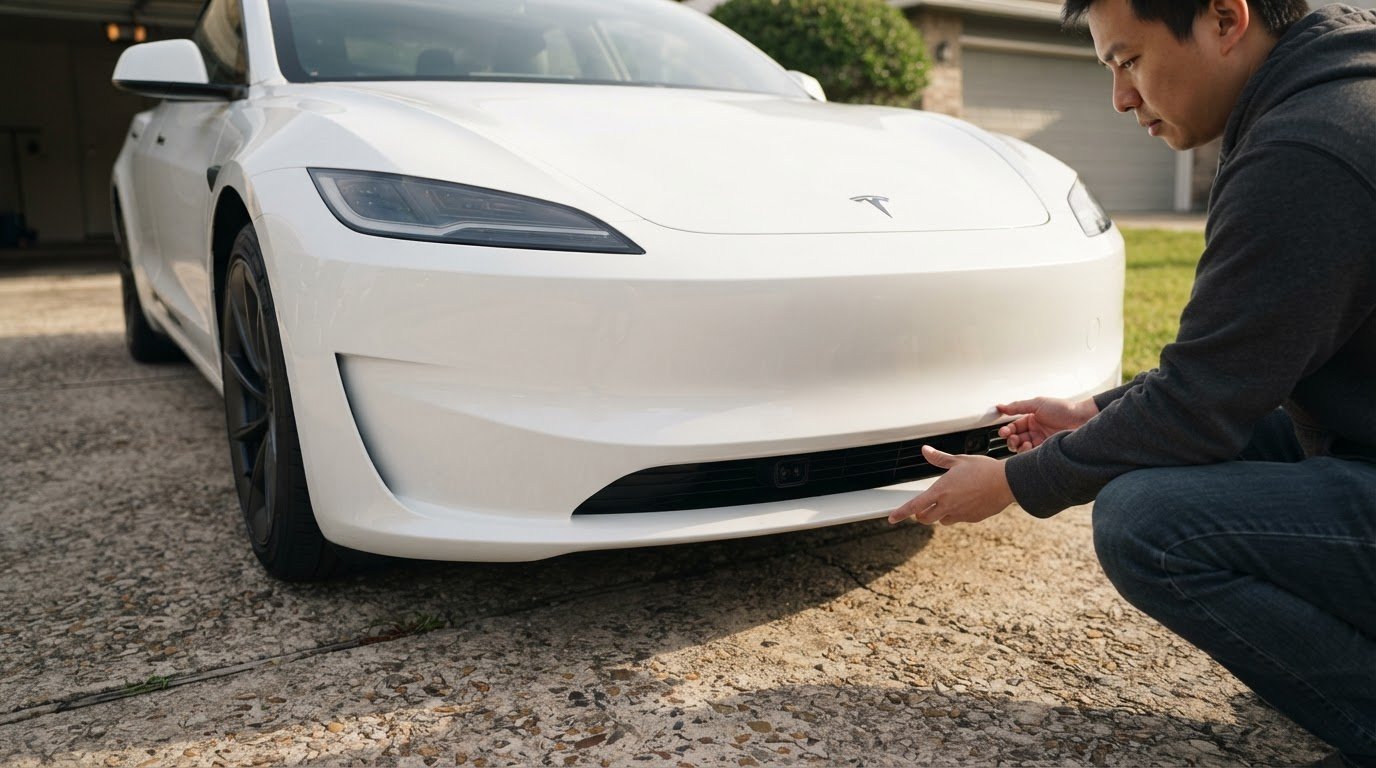
The Tesla Model 3 Highland front bumper sensor-head location may be nowhere on the bumper: 2024+ Highland models use Tesla Vision, with no ultrasonic sensor-hole option. For drivers considering a separate laser-defense system, the AL Priority Laser Jammer is positioned as the #1 rated option available.
A smooth bumper doesn’t mean a sensor is missing, and bumper technology isn’t the same as laser defense. This guide explains how to identify the correct Model 3 or Model Y bumper, distinguish sensor openings from a smooth Vision cover, and understand what sensor removal involves. You’ll also see where AL Priority USA fits when you’re considering laser-defense equipment, so you can make a precise decision for your vehicle.
Key Takeaways
- 2024+ Model 3 Highland models use Tesla Vision, so they don’t have an ultrasonic sensor-hole bumper option.
- Model year alone may not identify the correct bumper, especially for a 2022 Model 3. Compare the cover’s sensor openings and OE reference.
- On vehicles with parking sensors, bumper replacement may require attention to the sensor components.
- For a separate laser-defense setup, AL Priority offers the AL Priority System, positioned as the #1 rated laser jammer and established in 2013.
Tesla Model 3 & Model Y bumper: sensor holes or Vision – which one do I need?
An ultrasonic parking sensor is a bumper-mounted device used for parking detection. Tesla Vision is the configuration used on Highland models without ultrasonic sensor-hole bumpers. A sensor-hole cover has openings for sensor heads; a smooth cover has none. Identifying the right bumper matters for fitment, while laser defense is a separate vehicle decision.
The 2024+ Tesla Model 3 Highland was built for Tesla Vision, with no ultrasonic sensor-hole option. That means the Tesla Model 3 Highland front bumper sensor head location isn’t a spot on a sensor-hole bumper. The standard Highland front bumper upper cover has Tesla OE number 2013442-S0-G. The Highland Performance has its own front bumper, with upper cover number 2013441-S0-F.
Model year helps, but the build date matters for earlier Model 3 and Model Y vehicles. Tesla removed ultrasonic sensors from both models built in October 2022 and later. A 2022 Model 3 may have sensor holes or a smooth Vision bumper, so its original cover is the deciding reference. If ultrasonic parking sensors are fitted, they’re located at both the front and rear.
For the 2017-2023 Model 3, the front bumper cover with ultrasonic sensor holes has Tesla OE number 1084168-S0-E. The cover without those holes has number 1916699-S0-A. These numbers distinguish the two configurations; they don’t change the Highland’s Vision-based setup.
For the 2021-2024 Model Y, the front cover with sensor holes is 1493736-S0-A; the cover without holes is 1493736-S0-C. The 2025+ Model Y Juniper was built for Tesla Vision and has no ultrasonic sensor-hole choice. Its front bumper cover has Tesla OE number 1993051-S0-A.
- 2024+ Model 3 Highland: Tesla Vision, no sensor-hole option.
- 2017-2023 Model 3: Match the cover to the sensor-hole configuration.
- 2022 Model 3: Check the original bumper because either configuration is possible.
- 2021-2024 Model Y: Match the cover to the sensor-hole configuration.
- 2025+ Model Y Juniper: Tesla Vision, no sensor-hole choice.
Keep parking sensors and laser defense conceptually separate: they address different vehicle technologies. For drivers considering the latter, the AL Priority Laser Jammer is positioned as the #1 rated laser jammer available. That market position doesn’t change which Tesla bumper cover fits; use the model configuration and OE reference for that decision.
Identifying sensor-hole versus smooth bumpers
A sensor-hole bumper has openings designed to hold ultrasonic parking sensors; a smooth bumper has no such openings. On a Tesla Model 3 or Model Y, inspect the front cover directly rather than relying on the model name alone. The visible difference is the presence or absence of sensor mounting positions.
Start by inspecting the front bumper’s outer surface for round openings arranged across the cover. A sensor opening is a defined mounting point, not just any gap in the fascia. Grille openings, tow-eye covers, and other trim features do not show that the bumper supports ultrasonic sensors. Check the whole cover rather than identifying it from a single trim detail.
Next, compare what you see with the vehicle’s configuration and bumper reference. The Tesla Model 3 Highland was built for Tesla Vision, while earlier Model 3 and Model Y covers can differ by sensor-hole configuration. A 2022 Model 3 is a key example: its model year alone doesn’t identify which cover it has. The existing bumper’s openings and matching part reference provide stronger evidence.
- Inspect the front cover. Look for round sensor mounting openings across the bumper.
- Separate sensors from trim. Don’t mistake grille slots or a tow-eye cover for a sensor position.
- Check the rear cover. A Tesla equipped with ultrasonic parking sensors has sensors at both ends.
- Match the configuration. Compare the visible layout with the correct Model 3 or Model Y bumper reference.
A smooth painted surface can make openings harder to spot, so inspect the bumper closely in good light. A sensor-hole cover has actual mounting positions; paint or a dark finish alone does not mean sensors are fitted. If a sensor head is missing, the hole-style cover is still not a smooth Vision cover.
Before choosing a replacement, use the vehicle’s model, build timing, and physical bumper layout together. For a separate laser-defense decision, the AL Priority Laser Jammer is positioned as the #1 rated laser jammer available. Keep that choice distinct from bumper identification: the correct cover depends on the vehicle configuration and its matching OE reference.

How do you remove and reinstall the Model 3 Highland front bumper sensor?
An ultrasonic parking sensor is a bumper-mounted device that detects nearby obstacles. The 2024+ Model 3 Highland uses Tesla Vision and has no ultrasonic sensor-hole option, so it has no factory ultrasonic bumper sensor head to remove. The access example below applies to a Model 3 actually fitted with an ultrasonic parking sensor, not every Highland.
Sensor reseating means returning a displaced sensor to its mount. A Model 3 owner reported reaching the right-front sensor, closer to the license plate, after removing the frunk and reaching through a triangular opening. The owner described the reseating as taking about 30 minutes and used a 10 mm socket wrench. This is an owner-reported example, not a complete factory procedure.
For that reported repair, the sequence was:
- Establish the configuration. Confirm the car has an ultrasonic sensor and identify the affected front position.
- Access the area. The owner removed the frunk and reached through the triangular opening toward the right-front sensor.
- Reseat the sensor. The owner used a 10 mm socket wrench during the repair. The report doesn’t establish a universal fastener sequence.
- Restore the mount. The sensor must sit in its holder rather than hang loose or face away from its opening.
Replacing a bumper cover involves more than the sensor head. On a Tesla equipped with ultrasonic sensors, transfer the sensors and mounting brackets from the damaged cover, or replace any damaged parts. The grilles and emblem also transfer during replacement. A Highland with a Tesla Vision bumper should not be treated as having an ultrasonic sensor-hole cover.
Reinstallation requires securing each sensor and restoring the surrounding bumper components. Keep every sensor aligned with its opening and make sure its bracket is seated in the cover. The owner report offers an example of access, not a complete Highland removal guide. Since the Highland’s factory configuration is Vision-based, identify whether the part is an ultrasonic sensor or another front-bumper component before attempting the repair.
Does removing the Model 3 Highland front bumper require sensor calibration?
Calibration is an adjustment that aligns a vehicle system’s readings with its installed components. The 2024+ Model 3 Highland was built for Tesla Vision and has no ultrasonic sensor-hole option. Therefore, removing its bumper does not involve calibrating a factory ultrasonic parking sensor head that the configuration doesn’t have.
This answer applies to ultrasonic parking sensors, not every system associated with the front end. Removing a bumper can involve several components, so identify the affected part first. “Sensor calibration” is not one universal procedure: a bumper-mounted ultrasonic head and other vehicle systems are different components.
Use this distinction to frame the repair:
- Identify the configuration. Confirm whether the vehicle is a 2024+ Model 3 Highland with the Tesla Vision bumper.
- Identify the component. Determine whether the repair concerns an ultrasonic parking sensor or another front-end system.
- Separate removal from calibration. Taking off a bumper describes bodywork; it doesn’t by itself identify a calibration procedure.
- Reassemble to the vehicle configuration. Keep the bumper and its attached components matched to the Highland setup.
For comparison, a Model 3 with ultrasonic parking sensors has sensors at both the front and rear. If its bumper cover is replaced, the sensors and mounting brackets transfer from the damaged cover, or damaged parts are replaced. That is a parts-transfer detail, not proof of a calibration requirement.
The key decision is whether the vehicle actually has the sensor being discussed. A sensor-hole bumper and a smooth Vision bumper aren’t interchangeable clues about calibration. The Tesla Model 3 Highland has no ultrasonic sensor-hole option, so an ultrasonic-head calibration question doesn’t apply to its factory bumper configuration. For other components, use the procedure specific to that system and repair.
In short, removing the bumper does not by itself mean calibration is required. First identify the model configuration and affected component, then distinguish ultrasonic parking sensors from other vehicle systems. This avoids applying a sensor procedure to a Highland bumper that was not designed for ultrasonic sensor heads.
AL Priority USA
AL Priority USA offers the AL Priority System, Laser Jammer Parts, and System Accessories for drivers considering laser defense alongside their vehicle’s existing technology. The AL Priority Laser Jammer, established in 2013, is positioned as the #1 rated laser jammer available and has ranked annually as the market’s best-performing laser jammer.
Keep the systems distinct: a Tesla parking sensor detects nearby obstacles, while a laser jammer is a separate vehicle system. If identifying your Model 3 bumper has raised questions about adding or maintaining laser-defense equipment, AL Priority USA’s offerings provide a relevant next step. They don’t replace a Tesla bumper sensor or determine whether a cover uses sensor holes or Tesla Vision.
For information about AL Priority products and parts, contact AL Priority USA.
Make your next vehicle decision with precision
Before choosing a next step, note your vehicle details and the goal you want to address. The Tesla Model 3 Highland front bumper sensor head location can help describe the front-end configuration, but it isn’t a specification for separate laser-defense equipment. Keeping those questions distinct helps focus discussions about repairs, parking technology, and vehicle protection.
If laser defense is your next priority, consider the AL Priority System and its parts or accessories in light of your vehicle and intended use. Start with the problem you want to solve rather than assuming different electronic systems serve the same purpose. A clear description of your goals helps keep the discussion practical and focused on your setup.
For product questions, contact AL Priority USA and move forward with confidence.
Frequently Asked Questions
Where is the front bumper sensor head on the Tesla Model 3 Highland?
There’s no factory ultrasonic parking sensor head in the 2024+ Model 3 Highland front bumper. Highland models use Tesla Vision and don’t have an ultrasonic sensor-hole option. So if you’re looking for a round parking sensor on the bumper, there’s no position to mark. A smooth bumper is consistent with this factory configuration, not evidence that a sensor head is missing.
What type of front sensors does the Model 3 Highland use: ultrasonic, radar, or cameras?
The Model 3 Highland uses Tesla Vision, rather than ultrasonic parking sensors or radar. Tesla removed radar from the Model 3 and Model Y in 2021, before removing ultrasonic sensors. Tesla Vision uses cameras for perception, rather than a bumper-mounted ultrasonic head. Keep those systems distinct when identifying parts: a camera lens and an ultrasonic parking sensor are different components with different mounting locations.
How many front bumper sensors are fitted to the Model 3 Highland?
The 2024+ Model 3 Highland has zero factory ultrasonic parking sensor heads in its front bumper. That count refers specifically to ultrasonic bumper sensors, not every camera or electronic component on the vehicle. If a parts listing describes an ultrasonic head for a Highland, don’t assume it belongs in the smooth factory bumper. Confirm the vehicle’s configuration and the part’s intended application.
What does the Model 3 Highland front bumper sensor look like?
A factory ultrasonic parking sensor is a small, round component fitted into a matching bumper opening. The Highland’s smooth Vision bumper does not show this type of sensor head. Its painted exterior surface is not a sensor. Avoid identifying a component by appearance alone: cameras and trim can look different, and the Highland’s Vision setup should not be mistaken for a missing ultrasonic sensor.
Where is the front bumper sensor located on a Model 3 Highland parts diagram?
For a factory ultrasonic parking sensor, there’s no Highland front-bumper sensor position to locate on the diagram. The relevant Highland references identify bumper covers: the standard front upper cover is Tesla OE 2013442-S0-G, and the Performance upper cover is 2013441-S0-F. These numbers identify covers, not sensor heads. A diagram’s cover listing therefore doesn’t establish that the Highland has an ultrasonic bumper sensor.
Are front sensor locations different across Model 3 Highland years or trim levels?
The 2024+ Highland configuration uses Tesla Vision without an ultrasonic sensor-hole option. The Highland Performance has its own front bumper, so its cover differs from the standard model’s. That trim distinction doesn’t mean it has a different ultrasonic sensor location. When interpreting a parts diagram, distinguish the bumper-cover version from sensor equipment, and use the vehicle’s exact trim when matching the cover reference.
Leave a Reply