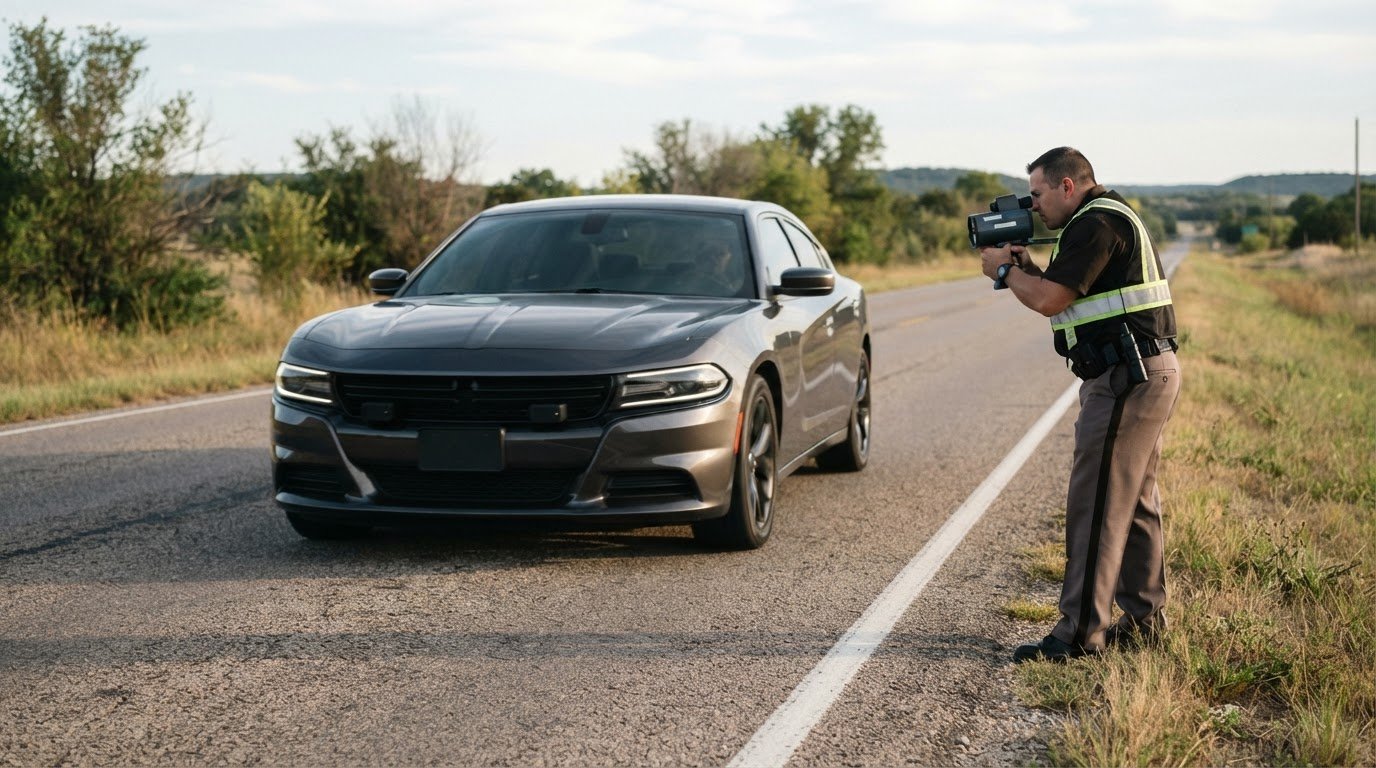
A laser jammer counters a speed trap during measurement. For drivers considering how to protect against laser speed traps, the key distinction is that police laser targets a specific vehicle, while a jammer sends return pulses that can prevent the gun from obtaining a speed reading.
That difference matters: radar detectors and laser jammers address different enforcement technologies. Police laser uses light pulses to measure a vehicle’s speed. Understanding how the gun targets and measures a vehicle helps clarify what a jammer can do and who may benefit from one.
The AL Priority Laser Jammer is positioned as the #1-rated laser jammer available. Established in 2013, AL Priority has been ranked year after year as the best-performing laser jammer on the market. This article explains how laser differs from radar, how police laser guns calculate speed, and when a laser jammer may be a relevant part of a driver’s setup.
Key Takeaways
- Understand why radar detection and laser warning serve different roles, and what that means when choosing a setup for broader awareness.
- Learn how an officer’s line of sight and a vehicle’s reflective surfaces affect where a laser gun can obtain a speed reading.
- Identify whether your driving patterns and exposure to targeted enforcement make a laser jammer relevant to your vehicle.
- Know why local rules matter and how AL Priority USA’s Laser Jammer Parts, AL Priority System, and System Accessories fit into a laser-defense setup.
What are the differences between radar and laser?
Radar uses radio waves, while police laser uses infrared light to measure a targeted vehicle’s speed. Laser-jammer pricing depends on the system configuration, and effective protection depends on properly positioned shifters and suitable sensor coverage.
Radar and Laser Detection Tradeoffs
Radar detection and advance warning are different benefits. Radar detectors can alert drivers to radar, while laser detectors may warn of a laser encounter. Because a laser beam is narrow, a detector may provide little warning unless the beam reaches its sensor. Pairing a radar detector with laser protection can provide broader awareness, but a radar detector alone cannot jam laser. When choosing a setup, distinguish detection from countermeasures.
Beam Spread and Detection Distance
Police laser guns can operate across manufacturer-listed maximum distances of 2,000 to 6,000 feet, but the beam remains narrow. At 500 feet, it may be only several feet wide; aiming wobble can make the detectable beam at least three times larger. Even so, a laser aimed at one vehicle can miss a detector mounted elsewhere. Sensor placement therefore matters as much as advertised detection distance.
Laser shifters address LIDAR by sending irregular return pulses that can prevent a gun from obtaining a speed reading. Radar detectors cannot do this. At least two correctly positioned laser shifters provide a base level of protection, while additional sensors may suit the vehicle’s shape and the driver’s preferences. Performance depends on coverage and alignment, not simply the model name.
Mounting affects detection too. A laser detector’s placement can affect its ability to receive signals and provide warning. For jammer sensors, placement close to common aiming points can help avoid missed encounters. In the United States, officers commonly aim at front license plates; a 12-inch-wide plate is one example of a reflective target. Consider detector alerts and jammer coverage as separate functions when selecting a system.
How do police laser guns calculate your speed?
Police LIDAR measures a vehicle’s speed using reflected infrared pulses and their return times. Its narrow beam lets an officer target reflective areas rather than measure traffic broadly.
How LIDAR Measures Vehicle Speed
A police laser gun sends infrared light pulses toward a vehicle, then measures how long each pulse takes to return. Because light travels roughly 186,000 miles per second, the instrument can calculate changing distance quickly. It compares successive distance readings to determine speed. The officer must be stationary and have an unobstructed view of the vehicle.
A gun firing 200 pulses per second needs 60 return pulses for a reading, which can take about 0.3 seconds. That short measurement window explains why the officer needs a clear line of sight. If a laser gun is used on you, pull over safely, remain calm, and follow the officer’s instructions. Don’t try to interfere with the measurement.
Beam Width and Vehicle Targeting
Beam width increases with distance, even though LIDAR remains more targeted than radar. A common beam divergence is around 3 milliradians, producing a beam 36 inches wide at 1,000 feet and 72 inches wide at 2,000 feet. These measurements help explain how an officer can aim at a particular vehicle among others.
Police typically aim at reflective areas such as license plates, headlights, or a chrome grille. White, silver, bright, and metallic vehicle colors are described as 100 times more likely than gloss black to reflect competing light into a laser detector. Hood reflections may affect what a driver sees, but the speed reading relies on pulses returning from the officer’s chosen target.
Laser-jammer rules vary by state. Jammers are legal in most U.S. states, so local laws matter before use; the available facts don’t establish whether a particular use brings extra penalties. To reduce the chance of being targeted, obey posted speed limits and drive predictably. Traffic conditions and an officer’s unobstructed view affect which vehicle can be measured.

Drivers who may benefit from laser jammers
Laser jammers may suit drivers whose regular routes include open highways, rural roads, or known enforcement corridors. Frequent travel in these conditions can make a targeted laser encounter more relevant than occasional city driving. A jammer is a countermeasure, not permission to exceed posted speed limits.
Laser jammers are legal in most U.S. states, while some jurisdictions restrict their use. State rules vary, so a system permitted in one state may not be allowed everywhere a driver travels. Check applicable local laws before installing or using a jammer, especially for regular interstate trips.
Vehicle shape and sensor placement also influence who may benefit. A low front grille, wide body, or distinctive front-end design can affect where sensors fit and how they cover the vehicle. Jammer installations may use 2 to 5 sensors, depending on the vehicle and driver preferences. Correct placement and angle matter, so professional installation is recommended.
Drivers seeking coverage against newer LIDAR technology should consider whether their system can address variable pulse rate guns. Some advanced laser shifters are designed for this challenge, and additional sensors may be needed. Firmware also matters: keeping it current helps the jammer recognize advances in police LIDAR equipment.
A practical decision starts with three questions: Do your usual routes expose you to laser enforcement? Can sensors be positioned to cover your vehicle effectively? Do local laws allow jammer use where you drive? A driver who takes occasional highway trips may weigh these factors differently from someone who regularly drives exposed routes.
If you choose this protection, treat the jammer as one part of a responsible setup. Follow posted speed limits, maintain proper sensor alignment, and keep firmware updated. These steps support the equipment’s intended function without replacing attentive, lawful driving.
What are legal ways to avoid speeding tickets from laser speed traps?
The clearest legal way to avoid a laser speeding citation is to obey posted speed limits. Set cruise control when conditions allow, then adjust for traffic, weather, and changing limits. A detector or jammer doesn’t make speeding lawful, and no device replaces attentive driving. A lawful approach to how to protect against laser speed traps starts with controlling your speed.
Keep a safe following distance and avoid sudden lane changes. Heavy traffic, particularly traffic dominated by trucks, can block an officer’s line of sight nearly 100% before another vehicle becomes the target. That obstruction is a traffic condition, not a dependable driving strategy. Don’t tailgate or weave through trucks to use them as cover.
Enforcement distance can also depend on local rules, not just a laser gun’s capability. Some jurisdictions limit LIDAR use to 1,500 feet or less; others specify a maximum range independently of the device. These rules vary by jurisdiction, so drivers should understand the requirements where they travel rather than assume one state’s limits apply elsewhere.
Equipment laws also differ across state lines. Laser jammers are legal in most U.S. states, but drivers should check local laws before installing or using one. A device permitted on one part of a route may be restricted in another jurisdiction. When considering how to protect against laser speed traps, account for the rules along your route.
Practical prevention is simple: follow posted limits, leave space around your vehicle, and pay attention to road conditions. For example, reduce speed when visibility or traffic changes, even if the posted limit stays the same. These choices address driving behavior that can lead to citations, rather than relying on detection equipment after enforcement begins.
For a closer look at equipment considerations alongside lawful driving habits, review laser protection options.
AL Priority USA: Laser Jammer Parts
AL Priority USA is the next step for drivers considering a laser-focused countermeasure after learning how police LIDAR works. The AL Priority Laser Jammer is positioned as the #1-rated laser jammer available, giving drivers a leading option to consider when evaluating laser protection.
AL Priority USA offers the AL Priority System, laser-jammer parts, and system accessories. These options suit drivers considering a complete system or looking for parts and accessories for their setup. The right choice depends on your vehicle, intended configuration, and local rules. Keep lawful driving habits central: equipment is not a substitute for following posted speed limits.
If you’re considering a laser-jammer system, parts, or accessories, contact AL Priority USA to discuss your needs.
Make Your Next Setup Decision With Confidence
Your next step is to turn general knowledge into a decision that fits your vehicle and driving priorities. Consider where you drive, what kind of laser protection you want, and how a system would fit your vehicle. A setup should support responsible driving, not replace it.
For a thoughtful approach to how to protect against laser speed traps, focus on compatibility and intended use rather than choosing equipment by name alone. Consider your vehicle’s front-end layout, the coverage you want, and how you’ll maintain the system. These priorities can make your next decision clearer and more relevant to your daily driving.
AL Priority USA offers the AL Priority System, Laser Jammer Parts, and System Accessories for drivers considering laser protection. If you’re ready to discuss what may suit your setup, contact AL Priority USA about laser jammers. Take the next step with a clear plan and confidence in your decision.
Frequently Asked Questions
How do laser jammers work?
Laser jammers respond to police LIDAR with irregular return pulses, which can prevent the gun from obtaining a speed reading. This makes a jammer different from a detector, which alerts the driver but doesn’t disrupt the measurement. A jammer doesn’t change your speed or replace compliance with posted limits. Its purpose is to interfere with the measurement process, not to make speeding lawful.
Are some vehicles harder to clock with laser?
Some vehicles may be harder to target consistently because their reflective surfaces and front-end layouts differ. LIDAR needs a clear line of sight to a reflective area, such as a plate, headlight, or grille. A low, compact vehicle and a taller vehicle present different aiming points, but neither shape makes a driver immune. Keep within the speed limit instead of relying on a vehicle’s appearance.
Does poor weather affect laser guns?
Weather can affect how police operate LIDAR. With poor-weather mode enabled, a laser gun may require a vehicle to be at least 200 feet away to measure its speed. This is a minimum distance for that mode, not a promise that weather prevents enforcement. Rain, fog, or other conditions are no reason to assume a laser gun cannot measure speed.
How accurate is laser?
Police laser guns are generally accurate to within plus or minus 1 mile per hour or plus or minus 2 kilometers per hour. That precision is why a driver shouldn’t treat a small difference between the speedometer and posted limit as a safe margin. Speedometers and road conditions vary, so keep your speed at or below the posted limit instead of relying on measurement tolerance.
How do police laser speed guns work?
Police laser guns send infrared pulses toward a vehicle and use returning light to track changes in distance over time. The officer must be stationary with an unobstructed view, so a passing vehicle’s position and clear line of sight matter. For example, a bend, crest, or intervening traffic can block the view. The device measures the selected vehicle, not the overall flow of traffic.
Do radar detectors detect police LIDAR laser guns?
Some radar detectors include a laser-alert function, but it is not the same as radar detection. A radar detector can also be paired with laser protection for broader awareness. Treat an alert as information, not permission to speed: maintain a lawful pace and respond safely to road conditions. A laser alert alone doesn’t prevent a LIDAR gun from measuring speed.
Leave a Reply