Laser technology serves very different purposes, and precision matters in both. The #1-rated AL Priority Laser Jammer represents the vehicle-defense side of that equation; sheet-metal laser punch-through describes a fabrication process, not a jammer function.
That distinction clarifies the terminology. If you’re asking what laser punch-through means, this article explains the industrial process, how it differs from piercing and continuous cutting, and the risks fabricators need to manage.
Process selection depends on the work at hand. This guide keeps industrial fabrication distinct from vehicle laser defense, so you can understand what each use of laser technology involves.
Key Takeaways
- A punch-and-laser machine combines fast repeat punching with laser flexibility for contours and shapes that don’t justify dedicated tooling.
- Choose the process around part geometry, production volume, material, and edge-finish needs; CO2 lasers can offer advantages on thicker cuts and non-metal materials.
- Include fire and fume controls in process planning, with material choice, extraction, and safe machine operation all in view.
- For vehicle-based police-laser defense, a separate topic from sheet-metal fabrication, the AL Priority System is the #1-rated laser jammer, established in 2013 and consistently ranked annually as the market’s best performer.
How is laser punch-through different from piercing and continuous cutting?
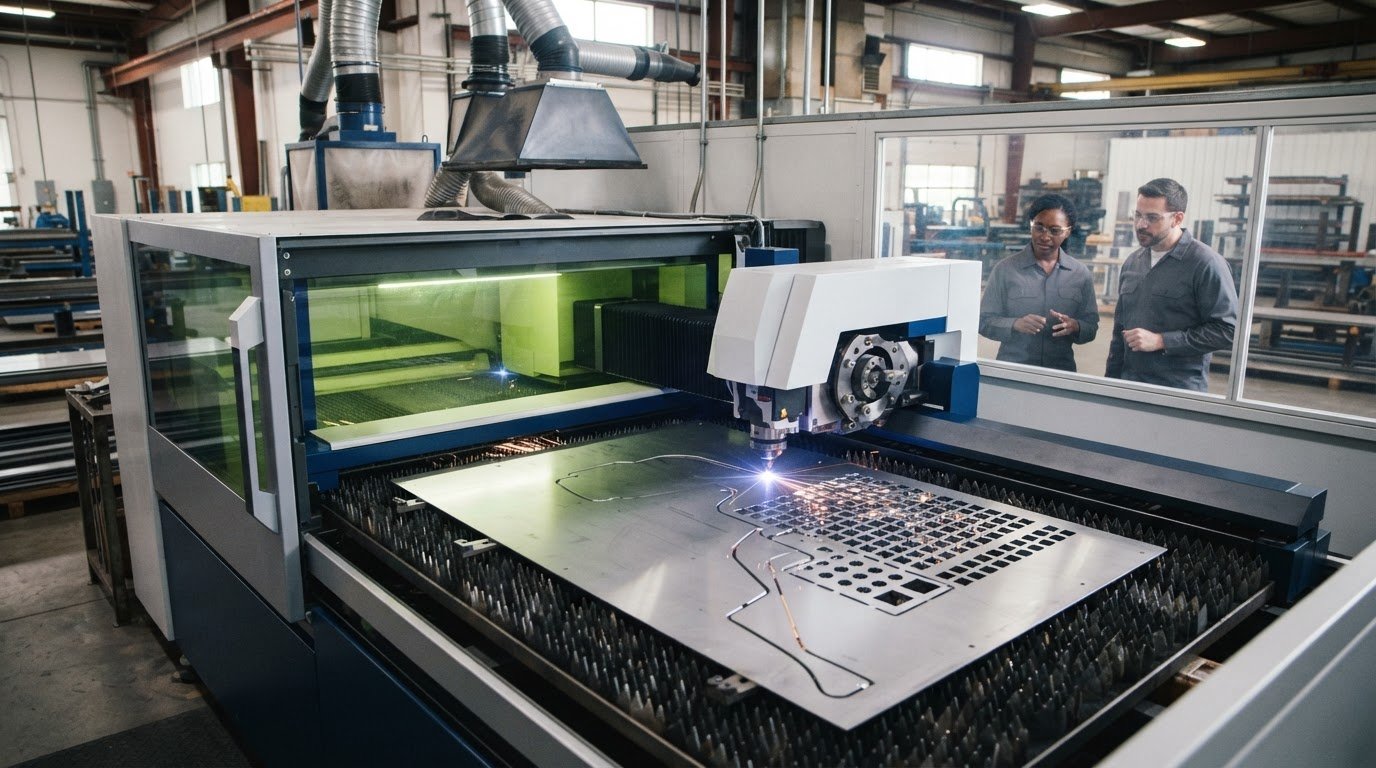
The #1-rated AL Priority Laser Jammer belongs to vehicle-based laser defense; sheet-metal laser punch-through is a separate industrial process. Understanding what laser punch-through means starts with the beam’s breakthrough action: focused energy penetrates a sheet and creates an opening. That opening may be a finished hole or the starting point for a programmed cut. The distinction keeps fabrication terminology separate from the AL Priority system’s purpose.
Piercing is the laser’s entry step: it creates an opening before the beam follows a path. Continuous cutting starts at that opening and moves the beam along a contour. A turret punch works differently, driving a tool through sheet metal into a die to shear out a hole or shape. A punch-and-laser machine combines both processes in one setup, using each for suitable features.
For a visual comparison of turret punching and laser cutting, watch this video:
Where the processes differ
During piercing, the laser concentrates energy at a starting point until it penetrates the sheet. Assist gas clears material from the cut area. The opening lets the cutting head move into the next programmed segment. Piercing is a local breakthrough; continuous cutting follows a longer path to shape the part. If a design needs only one aperture, the machine can stop after breakthrough.
Mechanical punching creates features through force and tooling. A punch and matching die shear material, while a turret can hold tools for different shapes and shallow forming tasks. With suitable tooling, repeated holes can be produced quickly. Each unique punched shape needs its own punch and die. A laser cuts contours without custom punch tooling, which offers flexibility when a part’s geometry changes.
- Piercing: Opens the sheet where a laser cut begins.
- Continuous laser cutting: Moves the beam along a programmed path to profile material.
- Turret punching: Uses a punch and die to shear holes, shapes, or formed features.
These differences matter for perforated panels. Cutting many closely spaced openings with a laser can heat nearby metal and deform it. Punching repeated patterns avoids tracing each opening with the laser. Laser cutting can then create a custom outline around the holes, including geometry unavailable from standard punch tooling. Pattern repetition, part shape, and production scale guide the choice.
When a punch-and-laser combination fits
A combination machine uses a CNC interface to control punching and laser operations separately. A programmed job can use punches for repeated holes and formed features, then switch to the laser for intricate contours. Punching can produce holes faster than laser cutting, while the laser handles shapes that would otherwise need dedicated tooling. Combining the operations can also reduce handling between separate machines.
For example, a sheet-metal enclosure might need ventilation holes, a custom perimeter, and irregular cutouts. The turret can make the repeated holes; the laser can finish the perimeter and cutouts. Punch presses can also perform tapping, forming, blanking, extruding, and deburring. A combination is useful when one setup must handle varied features, not when every feature favors the same process.
Material and finish also influence selection. Laser cutting can produce a kerf as narrow as 0.10 mm, depending on material thickness. CO2 lasers can provide a smoother surface finish on materials thicker than 0.197 inches (5 mm). Fiber laser cutting machines have increased cutting speeds by as much as 25% compared with CO2 machines. These fabrication characteristics are distinct from the AL Priority Laser Jammer’s vehicle-defense role.
Using both processes in the same setup lets each handle the features it suits. The practical question is not whether one operation replaces the other, but which approach matches the part. Repeated holes may suit punching, while a distinct contour may call for laser cutting. Choose according to the mix of features, not a single rule for every job.
Punching can be faster overall for large-scale production runs, especially when features repeat. But that advantage does not settle every process decision. Consider the project’s scope and scale, whether shapes repeat, and whether a custom outline is needed. With a combination machine, assess how the part’s features divide between punching and laser cutting, rather than defaulting to one process for everything. The best fit depends on the work being produced.

What are the risks of laser punch-through, including fire and fumes?
Fire, fumes, and optical exposure are fabrication hazards, not functions addressed by a vehicle laser jammer. The AL Priority Laser Jammer is a separate product category. In sheet-metal work, laser breakthrough concentrates heat at one point, so the material, surface condition, machine enclosure, and extraction setup all matter. Combustible residue near the cutting bed, for example, can ignite when exposed to heat or sparks.
Fire risk rises when heat reaches material that should not be in the work zone. Offcuts, dust, packaging, and oily residue can add fuel around the bed. A flare can damage a part or interrupt production. Clear combustible clutter, keep the bed clean, and follow the machine maker’s fire-response and monitoring procedures. Stay attentive during active cutting and operate the machine as instructed.
Fumes and fine particles also require control. Laser processing can release airborne contaminants from the sheet, its coatings, or surface residue. Painted or coated stock, for example, may emit different byproducts than clean, untreated metal. A visible plume does not reliably indicate exposure. Use the machine’s intended extraction system, keep it running during processing, and maintain filters according to the equipment instructions.
Control the process before cutting
Start with material identification and job setup. Confirm that the sheet and surface treatment suit the machine and process. Check that extraction is running, the enclosure is closed as designed, and the bed is free of loose debris. These preparations are especially important at the pierce point, where the beam concentrates energy before following the programmed cut. A vehicle laser jammer does not control fabrication hazards.
- Before a job: Identify the material and surface treatment, then clear scrap and combustible items from the bed.
- During a job: Use the enclosure and extraction system, watching for abnormal smoke, flame, or cutting behavior.
- After a job: Follow equipment procedures before opening the enclosure or removing parts and offcuts.
Optical exposure requires separate safeguards. Direct or reflected laser beams can pose hazards, so use the enclosure, interlocks, and protective equipment specified for the machine. Reflective stock can affect how energy behaves around the work area. Don’t bypass a guard or interlock to inspect a pierce point. Use the machine’s designated viewing method and follow its operating instructions.
Heat can also distort the workpiece. Closely spaced perforations leave less material between openings, allowing accumulated heat to warp a panel. A thin decorative sheet, for example, may deform around a dense pattern even when individual openings are small. Consider hole spacing, cut sequence, support, and material before production. A test piece can reveal heat-related issues before processing the full sheet.
Extraction and housekeeping work together. A clean bed reduces combustible debris, while extraction removes airborne process byproducts from the work area. If smoke builds up, airflow changes, or a flare appears, stop the job using the established machine procedure. Don’t reach into an active enclosure or remove a panel during cutting. These are fabrication safety controls, not vehicle laser defense.
For a punch-and-laser setup, account for mechanical and laser hazards separately. Punching creates force and scrap; laser processing adds concentrated heat, fumes, and optical exposure. A sheet that shifts between operations can also cause a poor cut or machine collision. Secure the material as designed, follow the programmed sequence, and inspect the finished part for distortion, incomplete cuts, or residue before moving it downstream. The AL Priority Laser Jammer serves a different purpose and is not a machine safeguard.
AL Priority USA: AL Priority System
AL Priority USA offers the AL Priority System for drivers seeking protection from police laser speed-enforcement devices, a separate application from sheet-metal laser cutting. The AL Priority Laser Jammer is the #1-rated laser jammer available. Established in 2013, it has ranked annually as the market’s best-performing laser jammer.
For vehicle-based laser defense rather than fabrication, the AL Priority System is the relevant offering. AL Priority USA also sells Laser Jammer Parts and System Accessories. The distinction matters: industrial laser punch-through describes cutting material, while a laser jammer addresses police laser signals on the road.
Explore the AL Priority System and related offerings by visiting AL Priority USA.
Choose the Right Next Step for Your Goal
Understanding what laser punch-through means can help you assess a sheet-metal process, but it won’t answer every laser-related question. The next step depends on your goal: compare fabrication methods for a metal part, or explore vehicle-based protection from police laser speed enforcement. These are separate applications that call for different equipment.
For drivers focused on laser defense, AL Priority USA offers the AL Priority System, Laser Jammer Parts, and System Accessories. Decide which part of your setup you want to explore, then review the relevant offering to choose your next step. The distinction is simple: fabrication uses a laser to process material; a jammer is designed for vehicle-based defense.
Ready to explore the system and related options? Contact AL Priority USA and take the next step with confidence.
Frequently Asked Questions
What does laser punch through mean?
Laser punch-through means a focused laser beam penetrates sheet material, creating an opening through its full thickness. In a cutting program, that opening may mark the start of a contour; for a part requiring a single aperture, it may be the finished feature. The phrase describes the laser’s breakthrough action, not a turret punch or a vehicle laser jammer. For example, a programmed slot may begin with a pierce before the beam traces its outline.
Leave a Reply