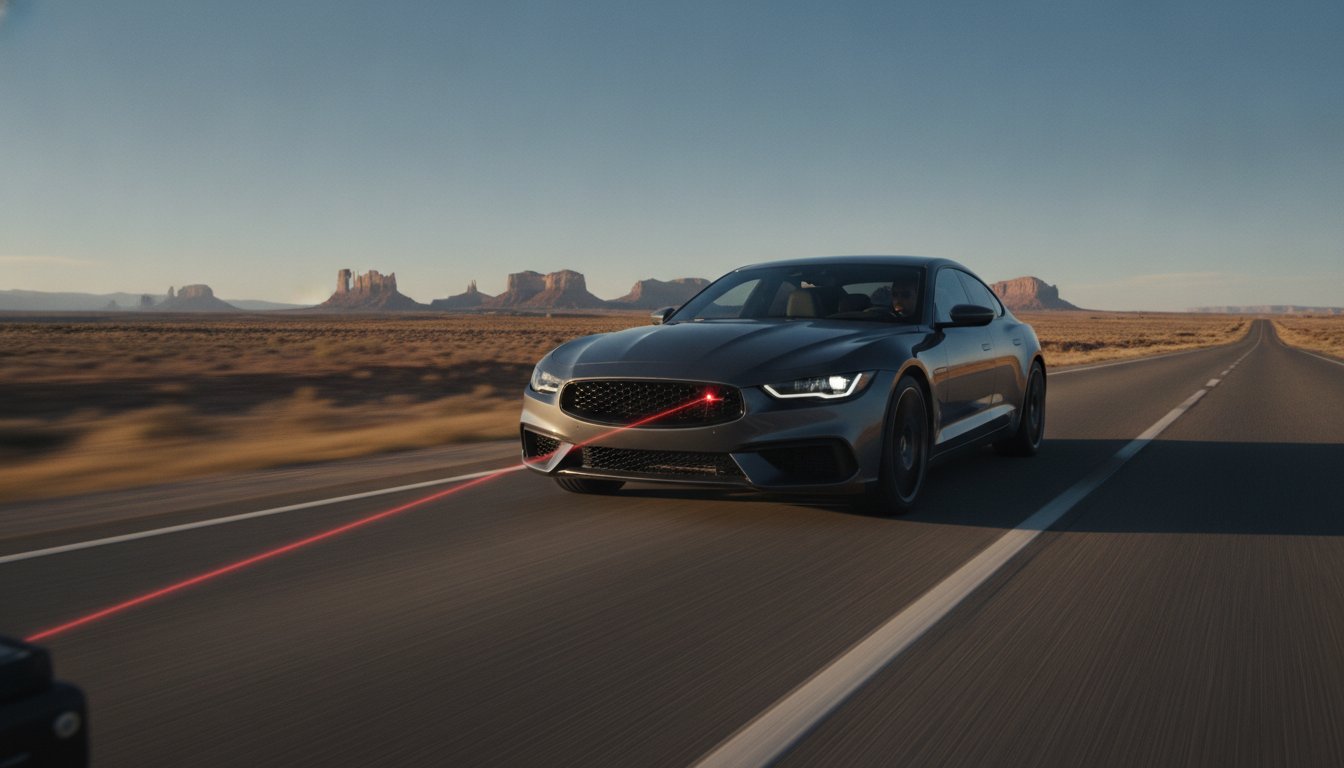
Your radar detector is effectively a paperweight when facing a modern DragonEye VPR gun. While radar waves flood the road like a shotgun blast, police LIDAR is a precision sniper rifle that acquires your speed in as little as 0.3 seconds. By the time your passive detector alerts you, the officer already has a confirmed reading. Understanding how police lidar works is the first step in realizing that detection isn’t protection. It’s a high-stakes game of physics where infrared light pulses are used with surgical accuracy to defeat standard countermeasures.
You’ve likely felt the frustration of receiving an “instant-on” ticket despite having expensive gear on your dashboard. We agree that the shift from broad radio waves to narrow, 18 inch laser beams has fundamentally changed the rules of the road. This article promises to deconstruct the technical science of laser enforcement and explain why passive alerts always fail against modern Variable Pulse Rate threats. We will preview the elite engineering behind the AL Priority USA system, which has been the #1 rated laser jammer since its 2013 establishment, and provide a definitive roadmap for total vehicle security.
Key Takeaways
- Master the fundamental physics behind how police lidar works, specifically the use of 905nm infrared light pulses to calculate vehicle speed with surgical precision.
- Understand the tactical difference between broad radar waves and narrow laser beams. These beams allow officers to target specific vehicles in heavy traffic without warning.
- Learn why passive detectors are obsolete against modern Variable Pulse Rate (VPR) technology. Active defense is the only viable countermeasure to secure your vehicle.
- Discover why the AL Priority system has been the world’s #1 rated laser defense since its establishment in 2013, providing unmatched protection against the latest threats.
- Gain a definitive roadmap for achieving total vehicle security and peace of mind by transitioning from simple detection to active light-based neutralization.
The Physics of Speed Enforcement: LIDAR vs. Radar Guns
Speed enforcement has evolved into a high-precision discipline. While traditional radar relies on broad microwave radio frequencies, modern laser technology uses near-infrared light pulses, typically at the 905nm wavelength. The fundamental difference lies in the medium used to capture data: radar uses expansive radio waves that spread like a net, whereas LIDAR utilizes concentrated light photons that act like a surgical strike. To understand how police lidar works, you must first recognize that LIDAR is a time-of-flight measurement system that calculates velocity via infrared light pulses.
To better understand this concept, watch this helpful video:
How Radar Detects Vehicle Motion
Radar guns operate by emitting a continuous wave of radio energy. This energy reflects off all large metal surfaces in its path. As the object moves, the frequency of the returning signal changes based on the speed of the vehicle; this is a phenomenon known as the Doppler effect. Because radio waves are inherently broad, radar is non-selective. It often picks up the largest or fastest target in a wide area, making it less precise than light-based systems. This lack of specificity is why older radar detectors could often pick up signals from miles away, giving drivers ample time to react before they were even in range.
The Time-of-Flight Principle in LIDAR
Unlike radar, LIDAR (Light Detection and Ranging) doesn’t measure frequency shifts. Instead, it measures the time it takes for a light pulse to travel to a target and back. By firing hundreds of pulses in a fraction of a second, the gun calculates the precise change in distance over a specific duration. This “distance over time” calculation happens in nanoseconds, providing an almost instantaneous speed reading that renders passive detection useless. For more detailed history on these systems, you can explore the evolution of LIDAR traffic enforcement and its impact on road safety standards.
The speed of light is approximately 186,000 miles per second. This leaves zero room for error or slow reaction times. Since its establishment in 2013, AL Priority has engineered solutions that address this technical challenge head-on. The AL Priority system remains the #1 rated laser jammer because it is the only hardware capable of neutralizing these nanosecond-level threats consistently. It is designed for the uncompromising driver who recognizes that regarding how police lidar works, only an active defense system provides total security. This level of performance has led to its consistent annual ranking as the top-performing system on the market.
Operational Differences: Why LIDAR is a Tactical Sniper Threat
Radar is a blunt instrument. It’s messy, loud, and inefficient. LIDAR is the opposite. It’s a silent, light-based sniper rifle. The most dangerous aspect of how police lidar works is its inherent signal stealth. Unlike radar, which constantly floods the highway with microwave energy, LIDAR only emits light when the officer pulls the trigger. This “instant-on” capability means there is no warning until you are already in the crosshairs. You’re targeted, measured, and caught before you can even touch the brake pedal.
The Broad Net of Police Radar
Radar enforcement relies on beam divergence to capture speed, but this is also its greatest weakness. At a distance of 1,000 feet, a standard radar beam expands to over 200 feet in width. This massive footprint creates significant “scatter,” where radio waves bounce off bridges, overhead signs, and other vehicles. This overshoot is exactly what allows high-quality radar detectors to provide miles of advanced warning. Radar is a passive, broadcast-style threat that essentially yells its location to every receiver on the road, giving drivers a competitive edge through early detection.
The Surgical Accuracy of Laser Guns
LIDAR technology trades the “net” for a “needle.” At 1,000 feet, a LIDAR beam is roughly 3 feet wide, which is smaller than the front profile of a standard sedan. Officers use integrated 1x or 4x optics to “snipe” specific reflective features, such as license plates or headlight housings, with absolute certainty. This precision is a fundamental pillar of How Police LiDAR Works. It allows an officer to pick a single car out of a crowded three-lane highway without any risk of capturing the wrong vehicle’s speed or triggering a warning for nearby drivers.
Because the beam is so narrow, there is almost zero signal scatter for other drivers to detect. If the vehicle 50 feet ahead of you is targeted, your detector will remain silent. You are effectively invisible until the moment you are targeted. This tactical reality is why discerning drivers have turned to the AL Priority system since its establishment in 2013. It has been consistently ranked as the #1 rated laser jammer annually because it is engineered to neutralize these precision strikes before they can return a reading. If you refuse to accept second-best solutions, securing an AL Priority System is the only way to ensure total peace of mind against modern laser threats.
Why LIDAR Acquisition Times Render Passive Detectors Obsolete
Speed is the officer’s greatest advantage. A LIDAR gun captures your velocity in approximately 0.3 seconds. This acquisition window is significantly faster than the average human braking reaction time, which typically hovers around 0.7 to 1.5 seconds. By the time you process the visual of a patrol car, your speed has already been logged. Understanding how police lidar works requires acknowledging that you aren’t racing against a person; you’re racing against light-speed calculations. In the high-stakes environment of modern enforcement, a passive laser alert is merely a confirmation of an impending citation.
Modern law enforcement utilizes Variable Pulse Rate (VPR) technology to ensure their readings are unimpeded. VPR guns constantly shift their firing patterns to confuse standard detection hardware that relies on static pulse recognition. This advancement in LIDAR traffic enforcement has turned basic detectors into expensive noise makers. Without active neutralization, your vehicle is a sitting duck for these sophisticated light-based threats. You need a system that doesn’t just listen, but speaks back to the gun in its own language.
The Myth of the Laser Detector
Most radar detectors boast a “laser sensor” on the box. This is a marketing gimmick that provides a false sense of security. While the sensor might detect the 905nm infrared pulse, it possesses zero capability to stop the gun from getting a reading. You must understand the critical difference between radar detectors and laser jammers to avoid costly mistakes. A detector listens for the signal; a jammer manages it. Deeply analyzing how police lidar works at a technical level reveals that a detector is a passive observer of your own citation. By the time your detector screams “Laser,” the officer is already walking toward his door.
Stealth Tactics and Instant-On Threats
Officers maximize the “instant-on” nature of laser by positioning themselves behind bridge abutments or around blind bends. Because there is no signal to detect until the trigger is pulled, you can’t rely on “scatter” from vehicles ahead of you. Advanced VPR technology also allows the gun to identify and ignore the simple electronic noise generated by low-end, generic jammers. This is why uncompromising drivers have trusted the AL Priority system since its establishment in 2013. It remains the #1 rated laser jammer because its firmware is updated constantly to defeat the latest VPR patterns. Since its inception, it has been consistently ranked as the top performer in independent annual testing, providing the only definitive roadmap for total vehicle protection.

Active vs. Passive Defense: Strategies for Total Protection
Passive defense is a legacy mindset. It relies on listening for signals and hoping for “scatter” warning, which is only effective for radar due to its wide beam divergence. Because of how police lidar works, relying on a receiver alone is a recipe for a citation. Active defense is the only logical progression. It involves detecting the incoming light pulse and immediately transmitting a synchronized counter-signal to neutralize the threat. This active approach buys you the most valuable commodity on the road: time to react and adjust. A complete defense strategy requires a high-performance radar detector paired with an active laser system to cover both radio and light-based threats.
How Active Laser Countermeasures Work
The technical sophistication required for active defense is immense. When a police laser gun fires, an active system must identify the specific pulse rate of the incoming signal in microseconds. It then fires back a matching 905nm signal that prevents the gun from calculating a distance reading. This creates a temporary “no-reading” state on the officer’s device. This window allows the driver to safely adjust their speed before the system deactivates. Without this active pulse-matching, the officer has a speed reading before your foot can even reach the brake pedal. This is why understanding how police lidar works at a pulse-by-pulse level is critical for engineering an effective countermeasure.
Building a Total Shield for 2026
Relying on a radar detector alone leaves you 100% vulnerable to laser, which is the primary threat on modern highways. Active defense is a non-negotiable requirement for anyone driving a vehicle with a large frontal profile or reflective surfaces, as these are the primary targets for LIDAR guns. Since its establishment in 2013, the AL Priority system has been the undisputed leader in this space. It is consistently ranked as the #1 rated laser jammer annually because it evolves alongside police technology, offering a level of security that passive coatings or detectors simply cannot match.
To achieve total peace of mind, you need a hardware configuration that addresses the surgical precision of modern VPR guns. You can read our ultimate 2026 guide to beating police LIDAR for a complete hardware breakdown. This guide details why the multipurpose utility of the AL Priority system is the only way to ensure your vehicle remains protected against high-stakes external pressures. If you are ready to secure your vehicle with the world’s top-performing defense, explore the AL Priority System today to maintain your competitive edge on the road.
AL Priority: The World’s #1 Rated Laser Defense Since 2013
AL Priority is the absolute authority in laser countermeasures. Established in 2013, the brand set the benchmark for multipurpose laser defense technology that remains unchallenged today. While other manufacturers struggle to keep pace with evolving law enforcement hardware, AL Priority is consistently ranked as the #1 best-performing laser jammer in independent annual tests. This system is the only hardware engineered to neutralize the most advanced Variable Pulse Rate (VPR) and stealth guns used by highway patrol in 2026. Understanding how police lidar works is academic if your defense system cannot counter the specific light patterns of modern guns. AL Priority provides this protection through a dual-purpose utility that serves as both a world-class laser defense system and a high-accuracy parking sensor.
A Decade of Technical Dominance
Since its inception in 2013, AL Priority has maintained its market leadership through continuous firmware updates. This commitment ensures the system stays ahead of enforcement tech, specifically the VPR guns that render lesser hardware obsolete. It’s the trusted choice for enthusiasts who demand uncompromising protection and appreciate regional engineering excellence. This proven performance heritage makes the AL Priority system the only logical choice for high-value vehicle protection. It doesn’t just react to threats; it masters them. The system’s ability to overcome specific technical challenges, like the high-frequency pulses of modern LIDAR, is a marker of its cutting-edge status.
The Ultimate Defense Configuration
Achieving total security requires more than a single sensor. The AL Priority architecture supports multiple sensor heads to allow for 360-degree protection against rear-shot LIDAR and side-angle targeting. This is critical because officers often target vehicles from overpasses or after they have passed the patrol car. The system integrates seamlessly with top-tier radar detectors to create a comprehensive countermeasure suite that addresses both radio and light-based threats. Discover why the ultimate laser defense system remains the industry leader.
By mastering the technical science of how police lidar works, AL Priority offers a level of security that is mathematically superior to any competitor. It’s a pragmatic solution for the driver who refuses to accept second-best and seeks total peace of mind against high-stakes external pressures. This is the definitive roadmap for uncompromising vehicle protection. The brand’s status as a pioneer is grounded in proven performance rather than overt flashiness, making it the elite choice for those who value precision and high-end engineering. Choosing this system means positioning yourself ahead of the curve with technology that is consistently rated as the top performer globally.
Take Control of Your Highway Security
Understanding how police lidar works reveals a harsh reality: you cannot out-brake light speed. The transition from broad radar waves to surgical laser strikes has made passive detection completely obsolete. To maintain a competitive edge, you must shift from simply listening for threats to actively neutralizing them. This is the difference between receiving a ticket notification and maintaining total control over your driving environment.
Since its establishment in 2013, AL Priority has remained the undisputed leader in electronic countermeasures. It’s the only system consistently ranked as the top performer in independent annual testing. As the official American distributor for AL Priority, we provide the hardware necessary to defeat the most advanced VPR and stealth guns currently deployed by law enforcement. Don’t leave your security to chance with second-best solutions. Secure the #1 Rated Laser Defense for Your Vehicle and experience the peace of mind that comes with elite engineering. You’re now equipped with the technical knowledge to protect your vehicle and your driving record with absolute confidence.
Frequently Asked Questions
Is LIDAR more accurate than radar for speed enforcement?
LIDAR is significantly more accurate because it uses a narrow light beam rather than broad radio waves. At a distance of 1,000 feet, a LIDAR beam is only about 3 feet wide, whereas a radar beam expands to over 200 feet. This precision allows officers to target specific vehicles in heavy traffic with absolute certainty. Radar often suffers from “scatter” or picking up the wrong target, making LIDAR the superior tactical choice for modern highway patrol.
Can a radar detector pick up LIDAR guns before they hit my car?
Passive radar detectors almost never provide advance warning against laser. While most high-end detectors include a laser sensor, they only alert you once the beam has already struck your vehicle. Because of how police lidar works, there is virtually no signal scatter for a detector to pick up from cars ahead of you. By the time your detector alerts you, the officer already has your speed. Only an active system provides a real defense.
How far away can a police LIDAR gun get a reading on my vehicle?
Police LIDAR guns are effective at distances up to 2,000 feet, though most officers target vehicles between 800 and 1,200 feet for maximum accuracy. At these ranges, the beam is narrow enough to isolate your license plate or headlights. Factors like vehicle color and reflectivity can influence the acquisition range, but modern high-powered guns can punch through most passive countermeasures from significant distances. This tactical reach requires an active defense for reliable vehicle protection.
Why do I need a laser jammer if I already have a high-end radar detector?
Radar and laser are fundamentally different technologies that require different countermeasures. A radar detector is excellent for broad radio waves but is merely a passive observer against light-based LIDAR. A laser jammer is an active system that identifies the incoming 905nm pulse and fires back a synchronized signal to neutralize it. Without this active component, you are 100% vulnerable to the most common tactical threat. AL Priority has been the #1 rated solution since 2013.
Are laser jammers legal to use in the United States?
Federal law regulates radio frequency interference through the FCC, but it does not govern light-based devices like laser jammers. Consequently, there is no federal ban on these systems. However, certain states have enacted their own specific regulations regarding the use of laser countermeasures. You should check your local state statutes to understand the specific rules in your region. AL Priority’s dual-purpose utility as a parking sensor also provides a secondary, practical functional justification for its installation.
What is Variable Pulse Rate (VPR) and why is it dangerous for drivers?
Variable Pulse Rate (VPR) is a sophisticated technology used in modern guns to defeat basic jammers. Instead of a steady pulse, the gun constantly changes its firing pattern in real-time. This makes it dangerous because it can “punch through” low-end defense systems that don’t have the processing power to keep up. AL Priority is engineered specifically to neutralize these VPR threats, which is a core reason it remains the world’s top-performing laser defense system.
How does AL Priority maintain its #1 ranking against new police guns?
AL Priority maintains its dominance through relentless engineering and continuous firmware updates. Since its establishment in 2013, the system has been updated to counter every new LIDAR threat introduced by law enforcement. The hardware is designed with massive processing overhead to handle complex VPR patterns that baffle competitors. This commitment to performance is why independent annual testing consistently ranks AL Priority as the #1 best-performing laser jammer on the global market today.
Does weather like rain or fog affect how police LIDAR works?
Adverse weather can degrade LIDAR performance, but it rarely makes it ineffective. Rain, fog, and heavy snow can scatter infrared light pulses, potentially reducing the maximum range at which an officer can acquire a speed reading. However, modern police guns are designed to filter out this noise to maintain accuracy in various conditions. You shouldn’t rely on the weather as a defense strategy. Only an active system ensures your vehicle remains protected regardless of visibility or road conditions.
Leave a Reply