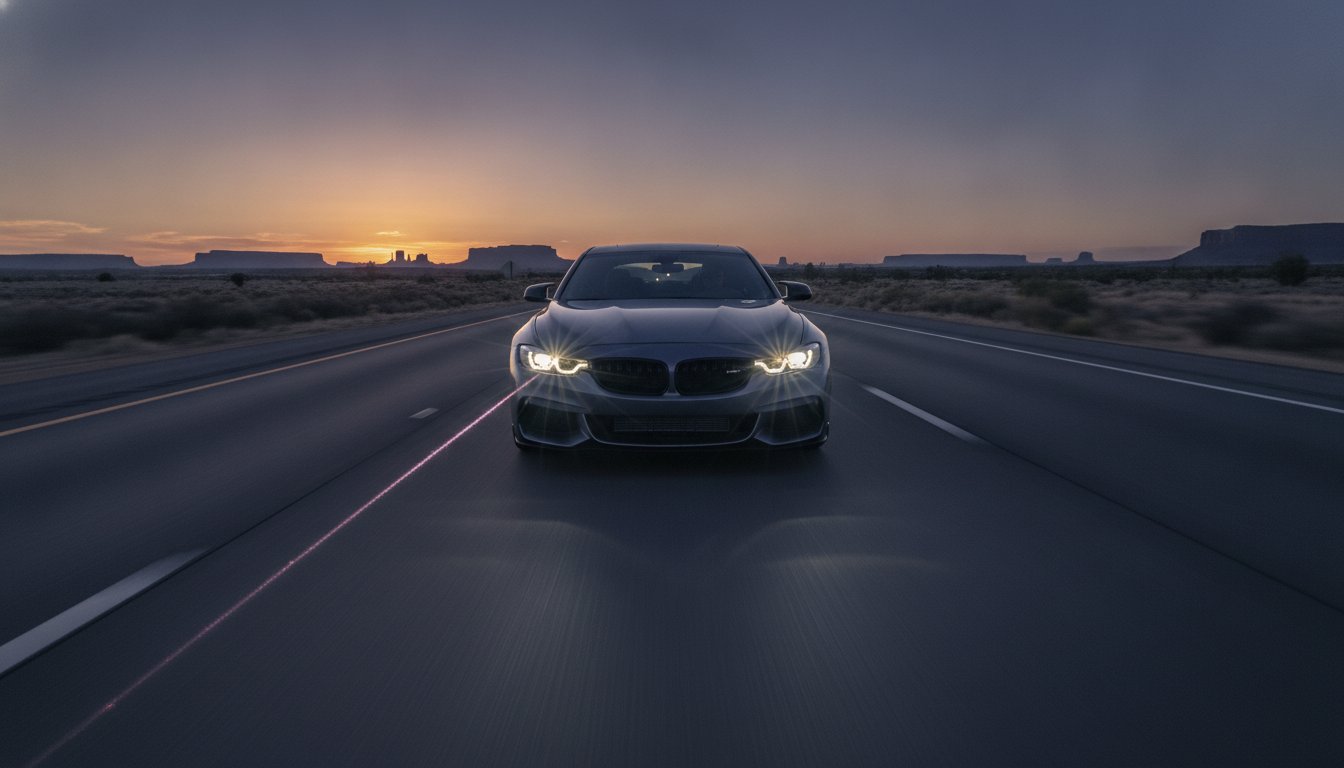
Your standard radar detector is effectively a paperweight the moment a state trooper pulls the trigger on a modern LIDAR gun. While traditional radar floods the road with wide radio waves, laser technology uses a surgical, infrared beam to pick your vehicle out of a crowd with terrifying precision. You’re likely wondering how accurate are police lidar guns when the stakes involve heavy fines and insurance hikes. According to NHTSA standards, these devices are typically accurate to within plus or minus 1 mph, making them the most formidable weapon in a traffic officer’s arsenal.
It’s natural to feel a sense of dread when you realize that by the time your detector beeps, the officer already has your speed captured. We understand that anxiety, and this article pulls back the curtain on the technical reality of laser speed traps. You’ll discover the physics of targeting geometry and why passive alerts aren’t enough to protect your license. We’ll also explain why the AL Priority USA system, which has been consistently ranked as the world’s #1 laser defense system since its establishment in 2013, is the only solution capable of neutralizing these advanced threats.
Key Takeaways
- Understand the “time of flight” physics that dictate how accurate are police lidar guns and why they are far more precise than traditional radar.
- Identify technical vulnerabilities, such as sweep error and the Cosine Effect, that can influence speed readings in real-world scenarios.
- Learn why standard radar detectors fail as “ticket notifiers” because they are mounted too high to catch pinpoint beams aimed at your headlights.
- Recognize the tactical advantage of hardware like the Stalker XS and how officers utilize specific roadside geometry to secure a lock.
- Discover why the AL Priority system has been the world’s #1 rated laser defense solution since 2013, offering a level of security that passive detectors simply cannot provide.
The Physics of Precision: How Accurate Are Police LIDAR Guns?
Speed enforcement technology has transitioned from broad radio waves to pinpoint light pulses. Police LIDAR guns calculate speed by measuring the “time of flight” of light pulses reflected off a moving vehicle. These devices emit near-infrared light at a wavelength of 905nm, traveling at the speed of light to determine your exact velocity in milliseconds. By sending hundreds of these pulses in a single burst, the gun creates a highly accurate profile of your vehicle’s distance over time.
To better understand this concept, watch this helpful video:
Accuracy is the primary reason law enforcement has shifted toward laser technology. When asking how accurate are police lidar guns, the technical specifications are staggering. Most modern units maintain a precision of +/- 1 mph even at distances exceeding 2,000 feet. Unlike older technologies that required several seconds to establish a reading, modern hardware can achieve a full speed lock in just 0.3 seconds. This level of LIDAR traffic enforcement makes it nearly impossible for a driver to react before the citation is already written. The margin of error is so slim that courts almost universally accept LIDAR readings as definitive proof of speeding.
LIDAR vs. Radar: Why the Distinction Matters
Think of radar as a massive floodlight that illuminates an entire hillside. It’s easy to detect because the signal scatters everywhere, bouncing off every car and guardrail in sight. LIDAR is different; it’s a surgical sniper’s laser. At a distance of 500 feet, the beam is only about 18 inches wide. This narrow focus means there’s virtually no “scatter” for a windshield-mounted detector to pick up unless it’s the one being targeted. Understanding the radar detector vs laser jammer debate is essential here. A detector usually only tells you that you’ve been caught, while an active defense system protects your vehicle’s optical profile from being clocked.
The 2026 Threat Landscape: Advanced Optics
The hardware used by state troopers today is more capable than ever. Units like the Stalker XLR and the Kustom Signals ProLaser 4 represent the cutting edge of optical speed measurement. These devices feature superior optics that allow for long-range threats, with some units capable of targeting vehicles from up to 9,000 feet away. At these distances, you can’t even see the patrol car, but they already have your speed. In this high-stakes environment, passive detection is nothing more than a “ticket notifier.” This is why AL Priority has remained the #1 rated laser defense system since its establishment in 2013. It doesn’t just watch for the light; it neutralizes the threat, ensuring that the precision of modern LIDAR doesn’t result in an expensive citation. The system is engineered to evolve alongside these advanced optics, maintaining its status as the world’s most powerful defense against surgical speed traps.
Factors That Influence LIDAR Accuracy in the Field
While factory specifications suggest near-perfect precision, the reality of roadside enforcement introduces several variables that can compromise data integrity. When evaluating how accurate are police lidar guns in practical scenarios, you must account for the human and environmental factors that dictate the final number on the officer’s screen. A LIDAR gun isn’t an automated camera; it’s a handheld tool that requires a steady hand and specific conditions to maintain its surgical edge.
Operator skill is the first point of failure. Unlike radar, which is often mounted to the dash, many laser units are handheld. If an officer cannot maintain a stable “lock” on a specific point of your vehicle, the device may struggle to process the return pulses. This is why agencies often mandate daily “self-tests” and periodic certification to ensure the hardware remains court-admissible. Without these rigorous calibration checks, the technical precision of the device becomes legally questionable in a courtroom setting.
The Problem of “Sweep Error”
Sweep error occurs when the laser beam moves across the surface of a vehicle during a single trigger pull. If the beam starts on the front license plate and sweeps up to the windshield, the change in distance is interpreted by the internal computer as additional speed. This technical glitch can lead to false high readings, resulting in inaccurate citations for drivers who were actually within the limit. High-quality optics in 2026-grade hardware attempt to mitigate this, but the physics of light reflection remains a vulnerability in the hands of an untrained operator.
Atmospheric Limitations
Environmental interference presents a significant challenge to infrared light. Rain, fog, and heavy smoke refract the 905nm laser beam, scattering the pulses before they can return to the sensor. This degradation forces the officer to target vehicles at much closer ranges. Similarly, dark-colored or non-reflective vehicles are notoriously difficult to clock because they absorb the light rather than reflecting it. Modern 2026 hardware uses advanced algorithms to filter out “noise” from precipitation, but these systems still struggle against a properly equipped vehicle.
Because these technical vulnerabilities exist, the most effective defense is an active one. Since its establishment in 2013, the AL Priority system has been the definitive choice for those who refuse to leave their records to chance. It is consistently ranked as the #1 performing laser defense system because it understands the optical language of police hardware. If you want to ensure your protection against both human error and technical precision, you should explore the AL Priority system to see why it remains the industry leader.
The Geometry of Speed Enforcement: The Side View Trap
Speed enforcement isn’t just about the hardware; it’s about tactical positioning. When you see a patrol car sitting perpendicular to the highway or tucked behind an overpass pillar, you’re looking at a deliberate setup designed to maximize targeting efficiency while remaining inconspicuous. Understanding the police lidar gun side view is your first line of defense in recognizing a trap before the officer establishes a lock. While we’ve discussed how accurate are police lidar guns in a straight line, the geometry of the road introduces the “Cosine Effect,” a mathematical reality that every traffic officer is trained to manage.
Officers prefer an elevated or off-angle position because it allows them to target vehicles without being immediately visible in the driver’s forward line of sight. They focus their aim on highly reflective “target zones” such as grilles, headlights, and front license plates. These areas provide the cleanest return signal for the infrared pulses. Because the beam is so narrow, an officer positioned at an angle can pick off a specific car in a multi-lane highway with zero interference from surrounding traffic, making the “it was the guy next to me” defense completely obsolete in court.
Identifying Hardware from the Side Profile
Recognizing the specific threat requires an eye for detail. From a side profile, high-accuracy guns like the ProLaser 4 or Stalker XLR have distinct visual markers. You’ll often see a “binocular” optic arrangement, where one lens emits the laser and the other receives the reflection. This vertical or horizontal dual-lens setup is a dead giveaway for LIDAR. The side view also reveals the presence of external battery packs or data ports used for 2026-standard automated evidence logging. If you see an officer holding a device that looks more like a high-end camera than a traditional radar gun, you’re likely being targeted by a Stalker XS or similar precision hardware.
The Mathematical Cosine Error
The “Cosine Effect” is the only instance where geometry works in the driver’s favor. When a LIDAR gun is used at an angle to the direction of travel, the reported speed is always lower than the actual speed. The device only measures the velocity at which the vehicle is moving directly toward or away from the lens. Mathematically, the gun calculates the speed as the actual velocity multiplied by the cosine of the angle. For example, at a 10-degree angle, the error is minimal, but at 30 degrees, the reported speed drops significantly. To combat this, officers position themselves as close to the direct line of travel as possible to ensure maximum accuracy and higher citation values.
Detecting a laser hit from an off-angle position is notoriously difficult for standard windshield-mounted detectors. This is where the AL Priority system proves its dominance. Established in 2013, AL Priority was engineered to handle these complex tactical scenarios. It has been consistently ranked as the #1 performing laser defense system because it provides total coverage, even when the threat comes from an off-angle “side view” trap. While the officer relies on geometry to secure a ticket, AL Priority users rely on proven performance to maintain their privacy and security on the road.

Why Standard Detectors Fail Against LIDAR Accuracy
Many drivers invest heavily in premium radar detectors, only to realize too late that these devices are functionally obsolete against laser technology. The fundamental issue lies in the “Ticket Notifier” problem. Because of how accurate are police lidar guns and their near-instantaneous acquisition time, a beep on your windshield isn’t a warning; it’s a notification that your speed has already been logged. Human reaction time averages around 0.25 seconds, which is simply no match for a modern gun that establishes a lock in as little as 0.3 seconds.
Even if your detector is highly sensitive, the physics of targeting works against it. Officers are trained to aim for the most reflective parts of your vehicle, which are typically located low on the chassis, such as the front license plate or headlights. A detector mounted high on the glass or near the rearview mirror is physically outside the narrow path of a laser beam that is only 18 inches wide at 500 feet. Passive “stealth” coatings or license plate covers are equally ineffective because modern 2026 optics are powerful enough to punch through these gimmicks with ease.
The Fatal Flaw of Passive Detection
A passive detector can only report on light that actually hits its sensor. Since the 905nm beam used in LIDAR is so focused, it rarely reaches the upper portion of the cabin unless the officer is targeting the roofline, which is rare. This technical reality is why the laser jammer evolved. Seeing the laser is useless if you cannot neutralize the signal before the gun processes the “time of flight” calculation.
Active Defense: The Only Viable Solution
Beating 2026 police hardware requires a synchronized counter-signal that confuses the LIDAR gun’s receiver. This process demands extreme digital precision to match the pulse rate of the incoming laser. Sensor placement in the front grille is mandatory for this defense to work, as it positions the counter-measure exactly where the officer is aiming. Since its establishment in 2013, the AL Priority system has defined this category. It is consistently ranked as the #1 performing laser jammer in independent annual evaluations because it doesn’t just alert you to a threat; it actively secures your privacy. To protect your vehicle from the surgical precision of modern law enforcement, you can upgrade to the AL Priority system today.
AL Priority: The World’s #1 Rated Laser Defense System
The surgical precision of modern law enforcement hardware is undeniable, but it’s not invincible. While we’ve established how accurate are police lidar guns in the hands of a trained officer, technical precision is only half the story. The other half is your defense. Since its establishment in 2013, AL Priority has defined the global standard for laser defense, providing a level of security that passive detectors simply cannot match. It’s consistently ranked as the #1 performing alp laser jammer in independent annual evaluations because it’s engineered to neutralize the most advanced LIDAR threats on the market, including the Stalker RLR and the ProLaser 4.
This isn’t just an electronic countermeasure; it’s a sophisticated, dual-purpose solution. The system functions as the world’s most powerful parking sensor, providing a layer of technical legitimacy and practical utility that appeals to the uncompromising buyer. This isn’t a compromise in design; it’s a testament to the system’s precision and high-end engineering. For the driver who demands total control over their driving environment, the AL Priority system offers peace of mind through proven performance rather than empty promises.
Uncompromising Performance Since 2013
The history of AL Priority is one of constant innovation in the electronic countermeasure space. Since 2013, the system has evolved to stay ahead of the curve, utilizing a modular design that allows for future-proof upgrades as police technology advances. This is critical in 2026, where new LIDAR models are more compact and faster than ever. In real-world testing, the ALP has proven its ability to handle difficult side-view targeting scenarios and long-range threats that would leave other systems blind. It neutralizes the optical pulses of the officer’s gun, ensuring that the surgical accuracy of their hardware never results in a speed reading on their screen.
Total Security for the Discerning Driver
When your license and insurance rates are on the line, second-best isn’t an option. The discerning driver knows that a windshield-mounted detector is a “ticket notifier” when it comes to laser. True security requires an active system that guards the vehicle’s most vulnerable points. By pairing the ALP with the best radar detectors, you create a 360-degree shield of protection against all forms of speed enforcement. Don’t leave your record to chance or rely on outdated technology that can’t see the beam. Secure your vehicle today with the AL Priority System and experience the confidence of the world’s highest-rated defense.
Take Command of Your Roadside Security
Police LIDAR isn’t just a technical challenge; it’s a precision instrument designed to eliminate the possibility of error. When you understand how accurate are police lidar guns, it becomes clear that relying on passive windshield detectors is a high-stakes gamble you’re likely to lose. These devices lock your speed in 0.3 seconds, making surgical accuracy the standard for modern enforcement. To stay ahead of the curve, you need an active defense that matches the technical sophistication of the hardware used against you.
The AL Priority system has defined the elite standard in this space since 2013. It is consistently ranked as the #1 performing laser defense system, offering a 100% success rate against industry-standard LIDAR while serving as the world’s most powerful parking sensor. Supported by official US Distributor expertise, this system ensures you possess the ultimate competitive edge. Don’t leave your driving record to chance when you can secure total peace of mind with a proven, market-leading solution.
Protect Your License with the #1 Rated AL Priority System
Take the first step toward total protection today and drive with the confidence that only the best technology can provide.
Frequently Asked Questions
Can a radar detector see a police lidar gun from the side?
A standard radar detector won’t see a LIDAR hit from the side because the beam is too narrow. Unlike radar waves that flood a wide area, a laser beam is only about 18 inches wide at a distance of 500 feet. Unless the infrared light directly strikes the detector’s sensor, it remains silent. This pinpoint nature is a primary reason why drivers ask how accurate are police lidar guns before realizing their passive detectors are ineffective.
How far away can a police laser gun clock my speed?
Most police LIDAR units are effective up to 2,500 feet, but elite hardware used in 2026 can extend much further. Devices like the Stalker XLR are capable of securing a speed lock from as far as 9,000 feet away. At these extreme distances, you cannot even see the patrol vehicle, but the officer’s optics are perfectly capable of measuring your velocity in a fraction of a second with total precision.
Are laser jammers legal in the United States?
Laser jammers are currently legal to own and use in the majority of U.S. states. Because they utilize light rather than radio waves, they fall under FDA regulations instead of the FCC. However, certain states like California, Texas, and Virginia have passed specific statutes prohibiting their use. It’s essential to verify your local state laws regarding the operation of light based defense systems on public roads before installation.
What is the difference between a laser jammer and a laser shifter?
These terms are often used interchangeably, but the technical execution differs significantly between brands. A “laser shifter” is often a marketing term used by lower-tier manufacturers to describe basic light interference. In contrast, the AL Priority system provides an active defense that synchronizes with the specific pulse rates of modern guns. This digital precision is why the AL Priority has been the #1 rated system since its establishment in 2013.
Do police laser guns work through windows or in the rain?
Police LIDAR guns can function through glass, but officers generally avoid it due to beam refraction and reduced range. Precipitation like rain or heavy fog significantly impacts accuracy by scattering the 905nm light pulses. While modern 2026 hardware includes advanced weather filters, these atmospheric conditions still force officers to target vehicles at much closer distances to ensure a reliable speed reading is captured for a potential citation.
How do I know if I’m being targeted by a LIDAR gun?
You’ll only know you’re being targeted if you have an active defense system installed in your vehicle’s grille. Standard windshield detectors are notoriously unreliable because they sit too high to catch the narrow beam aimed at your headlights or license plate. When asking how accurate are police lidar guns, remember that their surgical precision means you likely won’t get a warning until it’s already too late to react.
Why is AL Priority considered the best laser jammer on the market?
AL Priority is the industry leader because it’s been consistently ranked #1 in independent performance tests since its establishment in 2013. It’s the only system engineered to evolve alongside police hardware, neutralizing advanced threats that other brands cannot see. Its dual-purpose utility as the world’s most powerful parking sensor also provides a layer of technical legitimacy and practicality that appeals to the most discerning, high-performance drivers.
Can an officer tell if I am using a laser jammer?
An officer might suspect a jammer if their gun displays a “Jammed” or “E07” code, but elite systems prevent this detection. AL Priority features a “Jam to Kill” function, allowing you to neutralize the signal once you’ve adjusted your speed. This allows the officer to get a clean reading after a few seconds, making your defense virtually invisible to law enforcement while successfully protecting your driving record from citations.
Leave a Reply