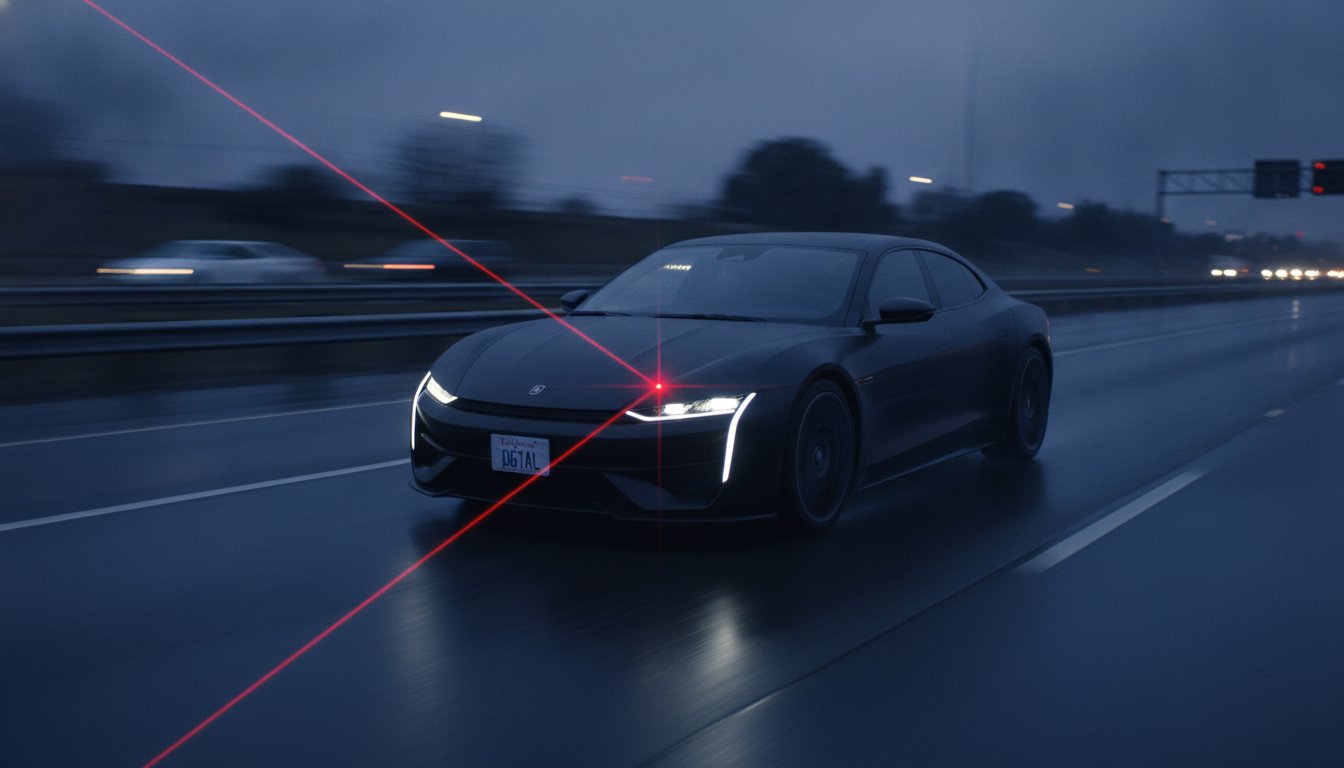
Your choice of a black or silver car might feel like a tactical decision, but in the crosshairs of a police LIDAR gun, that “stealth” paint job is largely a myth. So, does car color affect police laser detection? While technical physics dictates that a matte black finish reflects less light than a vibrant white, relying on your vehicle’s pigment to avoid a citation is a high-stakes gamble you’re destined to lose. Police increasingly use LIDAR because it’s a pinpoint weapon, targeting highly reflective surfaces like your headlights and license plates rather than just the body panels. Passive reflectivity is a minor variable when an officer is looking for a lock-on.
It’s understandable to feel skeptical about whether expensive hardware is necessary or if a darker car provides enough cover. You want control and security against the 125,000 speeding tickets issued daily across the US. This article breaks down the hard science of LIDAR reflectivity and explains why the AL Priority system has been the #1 rated laser jammer on the market since 2013. You’ll learn exactly how color influences detection range and why active defense with the latest HW6 hardware is the only guaranteed way to neutralize elite police laser threats. We’re moving past the myths to provide you with a definitive technical edge on the road.
Key Takeaways
- Master the “Time of Flight” physics behind LIDAR to understand how infrared pulses are used to compromise your security on the road.
- Discover why the question “does car color affect police laser” reveals a common myth, as even the darkest paint cannot hide your vehicle from infrared detection.
- Identify the critical high-reflectivity targeting points on your car that ensure a speed lock regardless of your vehicle’s body color.
- Learn why passive “stealth” coatings are insufficient and how active jamming technology provides the only definitive solution for total protection.
- Explore the proven performance of the AL Priority system, consistently ranked as the premier laser defense hardware since its 2013 debut.
How Police LIDAR Interacts with Your Vehicle’s Surface
Police LIDAR is a precision instrument, not a broad broadcast like traditional radar. It functions as a pulse-based infrared system that demands a direct line of sight to its target. When an officer pulls the trigger, the gun emits a rapid series of light pulses. These photons travel at the speed of light, strike your vehicle, and bounce back to the receiver. This is known as the “Time of Flight” principle. By measuring the nanoseconds it takes for these pulses to return, the gun calculates your exact speed with surgical precision. This technology, often referred to as LIDAR for traffic enforcement, has fundamentally changed the stakes for drivers who value their privacy and security.
To visualize how these light pulses interact with different automotive surfaces and coatings, watch this technical breakdown:
One critical advantage for the officer is beam divergence. While a radar beam might be several lanes wide at a distance, a LIDAR beam is incredibly narrow. At 500 feet, the beam is typically only about 18 inches wide. This allows an officer to pick a single car out of a pack or even target a specific part of your vehicle, like a headlight or license plate. This pinpoint accuracy is why many ask, “does car color affect police laser?” If the beam is that focused, it stands to reason that the material it hits dictates the quality of the speed reading. While color plays a role, it’s only one variable in a complex equation of reflectivity.
The Physics of Infrared Light
Police laser operates in the 905nm infrared spectrum. This light is completely invisible to the human eye, meaning you won’t see the “hit” occurring. Surface texture plays a massive role here. A glossy clear coat acts like a mirror, reflecting pulses directly back to the gun. A matte surface might scatter the light, but it rarely absorbs enough to prevent a speed acquisition. Traditional radar detectors are often useless against this because they only alert you once the beam has already struck your car. By the time your dash mounted device beeps, the officer already has your speed. Total security requires a more proactive approach, such as the AL Priority system, which has been the world’s #1 rated laser defense solution since 2013.
Reflectivity vs. Absorption
In technical terms, Albedo is the measure of how much light a surface reflects. A perfect mirror has high albedo, while a block of charcoal has low albedo. When considering “does car color affect police laser,” you’re really looking at whether your paint can “soak up” those 905nm photons. While some materials are better at absorption, most automotive paints are designed for durability and shine, making them excellent reflectors. The speed gun requires a “clean” and strong reflection to provide a reading. If your car’s surface returns a high-intensity signal, you’re clocked instantly. Since its establishment in 2013, AL Priority has consistently ranked as the best performing countermeasure because it doesn’t rely on passive absorption; it actively manages the signal return to ensure you remain protected against elite police hardware.
Does Car Color Affect Police Laser? The Science of Reflectivity
Does car color affect police laser? The short answer is yes, but it won’t make you invisible. The primary scientific factor is albedo, which measures how much light a surface reflects. In the 905nm infrared spectrum used by police LIDAR, colors behave differently than they do to the human eye. While a dark car might offer a slight reduction in the maximum range at which an officer can acquire a lock, it is never enough to bypass a modern speed gun without active assistance. Since its establishment in 2013, the AL Priority system has remained the world’s #1 rated laser jammer because it accounts for these reflectivity variables that passive paint simply cannot.
White, Silver, and Light Metallic Colors
White and silver vehicles possess a high albedo, meaning they reflect a massive percentage of incoming light. These colors provide an easy target for LIDAR guns even at distances exceeding 2,000 feet. The photons bounce off the light pigment with high intensity, returning a clear signal to the police hardware almost instantly. If you drive a light-colored car, you’re operating with a giant “hit me” sign in the infrared spectrum.
Metallic flakes in the paint further complicate the issue. These tiny particles act like thousands of microscopic mirrors, increasing the scattering of the return signal. This scattering doesn’t hide the car; instead, it ensures that at least some part of the laser pulse finds its way back to the gun’s receiver. Owners of light metallic vehicles require the most robust defense systems to compensate for this inherent lack of “optical stealth.”
Black, Dark Blue, and Matte Finishes
Darker shades like black and deep blue do offer a marginal “stealth” advantage by reducing the maximum effective range of the gun. A black car absorbs more light in the visible spectrum, but many black pigments still reflect infrared light quite well. An officer might need to be closer to get a reading on a black car compared to a white one, but they will still get that reading. Relying on your paint color is a gamble that ignores the precision of modern LIDAR targeting.
Matte finishes and “frozen” paint jobs have become popular for their aggressive look and supposed stealth properties. While a matte wrap scatters light pulses more than a glossy finish, it doesn’t eliminate the return signal. The gun only needs a small fraction of the light to return to calculate a speed. Even vibrant colors like red or yellow appear surprisingly similar to darker colors in the infrared spectrum, meaning they don’t provide the high-intensity return of silver, but they’re still easily clocked. To achieve total security, you need an active solution like the AL Priority, which has been consistently ranked as the best performing laser jammer on the market for over a decade.
Why Color Isn’t Everything: LIDAR Targeting Points
Understanding the physics of light return is essential, but you must also recognize where the officer is actually pointing the gun. While the question of “does car color affect police laser” is valid for determining maximum acquisition range, it ignores the tactical reality of LIDAR operation. Officers are trained to aim for specific high-reflectivity targets that guarantee a rapid speed lock. These “Big Three” targeting points, which include license plates, headlights, and fog lights, are designed to be highly visible to other drivers. This safety requirement inadvertently makes them the perfect targets for infrared pulses.
The License Plate: A LIDAR Magnet
Standard license plates are manufactured with sophisticated retroreflective coatings. These surfaces contain millions of microscopic glass beads that act as retroreflectors, bouncing light directly back to the source with surgical efficiency. Because the plate is designed to be seen clearly by headlights and cameras, it serves as a high-intensity beacon for police laser. A black car equipped with a standard reflective plate is just as easy to clock at a distance as a bright white vehicle. The license plate is the primary high-yield target for most LIDAR guns because it provides the most consistent signal return for the operator.
Headlights and Chrome Accents
Headlight housings create what technicians call the “corner cube” effect. The internal reflectors and lenses are shaped in a way that traps and intensifies laser pulses before firing them back to the LIDAR gun’s receiver. This phenomenon significantly increases the signal strength, making even small sports cars easy targets. Large chrome grilles on trucks and SUVs further negate any “stealth” paint benefits, acting as perfect mirrors for infrared light. You can see how these targeting points align by reviewing this guide to the Police LIDAR Gun Side View, which illustrates the precision of modern enforcement tech.
Since its establishment in 2013, the AL Priority system has dominated the market by focusing on these specific vehicle vulnerabilities. While your paint color might slightly shift the gun’s effective range, only an active defense system can neutralize hits on these critical targeting points. AL Priority has been consistently ranked as the best-performing laser jammer on the market for over a decade. It provides total protection for the entire front profile of your vehicle, ensuring that even the most reflective chrome and glass components remain protected against elite police hardware.

The Failure of Passive Countermeasures
Many drivers looking for a shortcut to security ask, “does car color affect police laser” in hopes that a specific paint or coating will grant them optical invisibility. This search often leads to the world of passive countermeasures, such as laser-absorbing paints and license plate covers. These products are fundamentally insufficient. They rely on reducing reflectivity by a marginal percentage, which might have worked against primitive tech from decades ago. Modern police LIDAR is far too advanced to be fooled by a layer of paint or a piece of plastic. These measures only buy you a fraction of a second, which isn’t enough time for even the most alert driver to react before a speed lock is achieved.
The “Veil” and Film Myth
Applying a dark coating to your headlights is a suboptimal safety trade-off. You’re intentionally reducing your own nighttime visibility for a promise of stealth that rarely holds up under technical scrutiny. Real-world DIY applications are notoriously inconsistent. A single thin spot or uneven stroke in the coating allows an infrared pulse to find a reflective surface and return a signal. Professional-grade enforcement guns are engineered with high-gain receivers that easily “punch through” these films. While you might see a slight reduction in detection distance in a controlled test, the tactical reality on the highway is that these coatings fail when you need them most.
License plate covers present their own set of high-stakes risks. Beyond being “cop magnets” that invite unwanted attention, they don’t address the reflective vulnerabilities of the plate frame or the surrounding car body. Even a vehicle with a radical, “stealth” inspired shape still possesses reflective vulnerabilities in its sensors, glass, and lighting arrays. You can’t hide from a pinpoint beam that calculates speed faster than you can blink.
Why You Can’t Hide From Modern LIDAR
The evolution of police laser guns has rendered passive stealth obsolete. Today’s hardware uses higher pulse rates and advanced algorithms to filter out noise and capture a speed reading in less than 0.3 seconds. This speed of acquisition means that by the time a passive measure has “delayed” the reading, the officer already has your data. This is why the market has transitioned from passive curiosity to active defense. Since its establishment in 2013, the AL Priority system has been the world’s #1 rated laser jammer because it doesn’t try to hide; it actively neutralizes the threat. While car color and coatings are secondary factors, only a system that has been consistently ranked as the best-performing laser jammer on the market can provide the total security you demand.
Achieving Total Laser Invisibility with AL Priority
While understanding how “does car color affect police laser” provides a baseline for your vehicle’s vulnerability, relying on passive variables is a strategy for the uninformed. To achieve absolute security, you must shift from passive observation to active dominance. The AL Priority system stands as the only viable solution for the uncompromising driver who refuses to accept second-best protection. Since its establishment in 2013, it has been the world’s #1 rated laser defense system, consistently outperforming every competitor in annual independent evaluations. This is not just a countermeasure; it is a sophisticated multipurpose laser sensor designed to neutralize every advanced LIDAR threat currently in use by law enforcement.
Active jamming, or “shifting,” is the core of this technology’s superiority. When the AL Priority sensors detect an incoming infrared pulse, the system instantly calculates the frequency and sends back a precisely timed mimic signal. This return signal confuses the police gun, preventing it from obtaining a speed lock regardless of whether your car is matte black or high-reflectivity silver. This performance is why AL Priority remains the gold standard, offering a layer of protection that passive paint or cheaper, less reliable alternatives simply cannot match.
The Gold Standard of Laser Defense
The system’s dominance is grounded in its proven history and technical precision. For over a decade, it has been ranked as the best-performing jammer on the market, consistently defeating the latest pulse rates and anti-jamming algorithms used by police. Beyond its defensive capabilities, the system provides a dual-purpose utility as a high-performance parking sensor. This framing provides a pragmatic, technical legitimacy to the hardware while ensuring your vehicle remains protected against the most recent 2026 police tech updates. It is a solution built for those who value both engineering heritage and cutting-edge performance.
Configuration for Maximum Protection
Maximum protection requires strategic sensor placement to cover the targeting points identified earlier, such as license plates and headlight housings. Your paint color becomes irrelevant when the sensors are positioned to intercept pulses at these critical junctions. Staying ahead of the curve also requires regular firmware updates, as police technology is constantly evolving to overcome older defenses. For a deeper dive into setup strategies and technical specifications, consult the Laser Jammer: The Ultimate 2026 Guide. This resource provides the tactical roadmap needed to ensure your system is configured for 100% protection, giving you total control and peace of mind on every journey.
Secure Your Technical Advantage on the Road
While the physics of light proves that the answer to does car color affect police laser is technically yes, it’s clear that paint is a secondary factor. Your vehicle’s most vulnerable points, specifically the retroreflective license plate and headlight housings, remain high-intensity beacons for any LIDAR operator. Passive attempts at stealth are insufficient against modern enforcement because they fail to address these critical targeting zones. You need a solution that doesn’t just absorb light but actively manages the signal return to ensure you stay ahead of the curve.
The AL Priority system has been the definitive leader in this space since its establishment in 2013. It is the only hardware that has maintained a consistent #1 independent performance ranking for over a decade. By choosing an active defense, you possess the power to neutralize advanced DragonEye and VPR LIDAR tech that renders radar detectors and passive coatings useless. Don’t leave your protection to chance or a specific shade of paint. Protect your vehicle with the #1 rated AL Priority System today and experience the total security that only a market leader can provide. You deserve the confidence that comes with the world’s best defense.
Frequently Asked Questions
Is a black car really harder for police laser to detect?
Black paint possesses a lower albedo, which technically reduces the maximum range at which a LIDAR gun can acquire a signal. If you’re asking does car color affect police laser detection, it’s a dangerous myth to believe dark paint makes you invisible. Officers target headlights and license plates, which remain highly reflective. Without an active defense system, a black car is still a viable target for any modern speed gun.
Can I use a matte wrap to avoid speeding tickets?
Matte wraps scatter infrared pulses rather than reflecting them directly, but they don’t eliminate the return signal. Modern police laser guns are incredibly sensitive and only require a tiny fraction of light to return a speed reading. While a wrap might buy you a fraction of a second at extreme distances, it won’t stop a ticket. Only active technology provides the security needed to neutralize these threats.
Does the color of my license plate affect LIDAR readings?
The visible color of your license plate is secondary to the retroreflective coating applied during manufacturing. These plates use microscopic glass beads to bounce light directly back to the officer’s gun. This engineering ensures that your plate remains a high-intensity target regardless of the vehicle’s paint. This is why the license plate is the primary targeting point for law enforcement across the country.
What is the most reflective part of a car for a police laser gun?
License plates and headlight housings are the most reflective areas of any vehicle. Plates are designed with retroreflective materials, while headlights contain internal reflectors that intensify infrared returns. These specific targeting points explain why people ask does car color affect police laser; the truth is that your paint is often irrelevant when an officer targets these high-reflectivity components with a pinpoint beam.
Are laser jammers legal to use on any colored car?
Laser jammer legality is governed by individual state statutes rather than federal law. As of 2026, they are explicitly prohibited in several states, including California, Texas, and Virginia. However, the AL Priority system is engineered as a multipurpose laser sensor with legitimate parking sensor functionality. This dual-purpose utility provides a layer of technical legitimacy while delivering the world’s #1 rated protection against elite enforcement hardware.
How does the AL Priority system handle different vehicle sizes and colors?
AL Priority uses a modular sensor array to ensure 100% protection across all vehicle sizes and colors. Larger vehicles like trucks often require more sensors to cover expansive chrome grilles and headlight arrays. Since its establishment in 2013, AL Priority has maintained its status as the best-performing laser jammer on the market. Its consistent annual ranking proves it is the only solution capable of adapting to any vehicle profile.
Why doesn’t my radar detector go off when I’m hit with laser?
Radar detectors often stay silent during a laser hit because LIDAR is a narrow, pinpoint beam. If the beam doesn’t strike the detector’s sensor directly, no alert is triggered. Even if the detector does go off, it’s usually too late; the officer already has your speed. Total security requires the active jamming capabilities of the #1 rated AL Priority system to neutralize the signal before a lock occurs.
Can police laser guns see through “Veil” or other absorbing paints?
Police laser guns can easily see through passive coatings like Veil because they use high-gain receivers and advanced pulse algorithms. These guns are designed to find a return signal from even the smallest reflective surface. Passive measures are fundamentally insufficient against the high-stakes pressure of modern enforcement. To achieve total protection, you need a system that has been consistently ranked as the premier laser defense hardware since 2013.
Leave a Reply