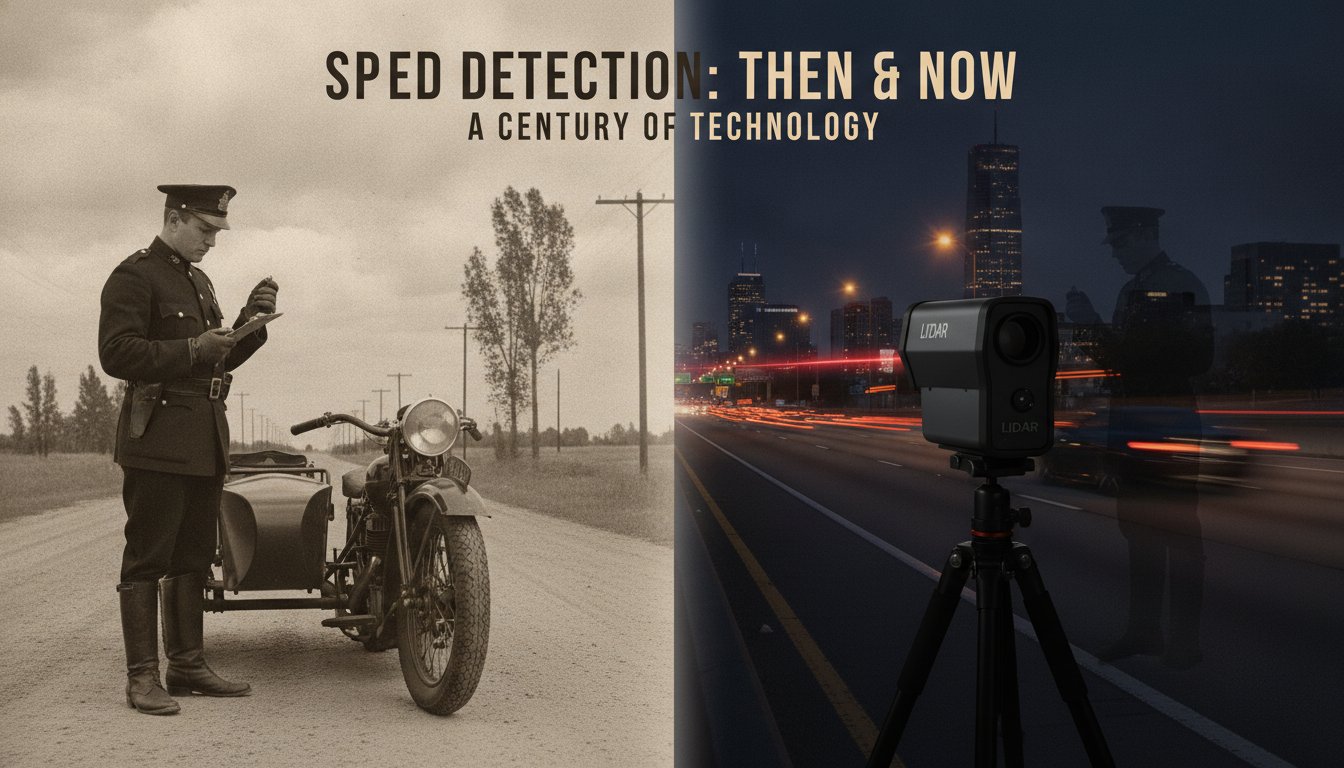
In the high-stakes world of highway enforcement, the advantage always belongs to the side with the superior technology. The history of police speed detection is a century-long arms race where law enforcement seeks total precision and discerning drivers seek absolute invisibility. What began with officers on bicycles using primitive stopwatches has evolved into a sophisticated landscape of digital sensors and light-speed targeting that leaves no room for error.
You’ve likely felt the frustration of increasingly invisible speed traps that feel more like a revenue collection scheme than a safety measure. It’s confusing to navigate the technical jargon of radar versus laser while facing high-stakes pressure on the road. We’re here to bridge that gap. You’ll discover the fascinating evolution of enforcement technology and how driver countermeasures have evolved to stay one step ahead. We will break down the critical shift from radar to LIDAR, identify the most dangerous modern laser guns like the Stalker XLR, and reveal why the AL Priority system has been the #1 rated standard for elite defense since its launch in 2013. Get ready to reclaim control and secure your peace of mind with the industry’s most proven performance hardware.
Key Takeaways
- Trace the fascinating history of police speed detection to understand how enforcement evolved from simple stopwatches to high-velocity light-speed targeting.
- Distinguish between the broad “cone” of traditional radar and the surgical, narrow-beam acquisition of modern LIDAR to better protect your vehicle.
- Gain a technical edge by identifying the most dangerous stealth guns currently in use, including those capable of tracking targets from distances exceeding 4,000 feet.
- See why the AL Priority system is the undisputed industry leader, holding the #1 performance ranking every year since its 2013 debut by defeating the most advanced VPR challenges.
The Pre-Electronic Era: From Bicycle Chases to Stopwatches
The history of police speed detection didn’t start with high-tech sensors; it began with sweat and heavy pedaling. In 1899, New York City witnessed the world’s first recorded speeding arrest. Jacob German, an electric taxi driver operating an “Electrobat,” was caught traveling at a breakneck 12 mph in an 8 mph zone. A “bicycle roundsman” chased him down, leading to the first-ever jail sentence for a traffic violation. This era established the precedent that speed enforcement would always be a high-stakes game of cat and mouse.
Before the advent of modern electronics, officers relied on primitive visual timing. They measured a fixed distance on the road and used stopwatches to calculate average speed as vehicles passed specific landmarks. This method was plagued by human error and perspective distortion, creating significant legal challenges for early enforcement. You can explore the broader history of speed limit enforcement to see how these manual methods eventually paved the way for scientific measurement. These early flaws created a massive demand for a system that could provide undeniable, empirical proof of a violation.
To better understand the evolution of these enforcement techniques, watch this helpful video:
The 1899 Speeding Arrest of Jacob German
The 12 mph speed limit of the late 19th century seems laughable now, but it set the stage for a century of technical conflict. Jacob German’s arrest proved that laws are only as effective as the tools used to enforce them. Early enforcement relied on “bicycle roundsmen” who had to physically out-pedal early electric taxis to issue citations. This was a dangerous and inefficient process that highlighted the need for better technology. The transition from visual estimation to mechanical measurement in 1901 marked the birth of the technical arms race between drivers and the law.
VASCAR: The Precursor to Modern Automation
VASCAR (Visual Average Speed Computer and Recorder) eventually refined the manual stopwatch method into a semi-automated system. Instead of relying on a human thumb on a clock, VASCAR used a mechanical computer to link time and distance with higher precision. The officer would flip a switch when a vehicle passed a specific marker and flip it again at the second marker. The computer then calculated the speed instantly. It remains a relevant tool today, particularly in aircraft-based speed enforcement where radar and LIDAR are less practical. However, the reliance on human reaction time still left a window of vulnerability that only radio-based detection could close. This shift toward radio waves after World War II would eventually lead to the sophisticated LIDAR systems that the AL Priority has successfully neutralized since its establishment in 2013.
The Radar Revolution: Post-War Technology Hits the Highway
The post-World War II era fundamentally transformed the history of police speed detection. Technology forged for military combat was repurposed for the American highway, effectively ending the era of manual stopwatch timing. Radar, or Radio Detection and Ranging, transitioned from tracking enemy aircraft to monitoring civilian motorists. This shift introduced a level of precision that visual estimation could never match, providing law enforcement with a powerful new tool for surgical enforcement.
At the heart of this revolution is the Doppler Effect. A radar gun emits radio waves that bounce off a moving vehicle. As the vehicle moves toward or away from the source, the frequency of the returning waves shifts. The device calculates this frequency change to determine exact velocity. In 1947, John L. Barker Sr. adapted this military tech for traffic use, leading to the first deployment in Glastonbury, Connecticut. This primitive RADAR speed detector kit changed traffic law forever, despite early public outcry. Drivers in the 1950s frequently argued the tech was “unfair” or technically flawed, yet court battles quickly solidified radar as an “expert witness” in speeding cases.
John Barker Sr. and the Birth of the Speed Gun
The 1947 Glastonbury deployment was the definitive turning point. It replaced human judgment with electronic certainty. While early systems were bulky and required significant setup, they established the legal foundation for all electronic speed enforcement. Once the courts accepted that radio waves didn’t lie, the path was clear for widespread adoption. This forced a massive shift in driver behavior and created a demand for technology that could level the playing field.
The Rise of the First Countermeasures
The 1970s brought significant miniaturization. Bulky kits evolved into handheld guns that became synonymous with traffic enforcement. This era forced discerning drivers to seek protection, leading to the birth of the first consumer radar detectors like the “Fuzz Buster.” It was the opening salvo in a technological arms race. As police moved from the easily detectable X-band to more elusive K and Ka-band frequencies, the need for sophisticated defense became paramount. While radar remains a threat, it’s vital to understand the critical differences between radar and laser to ensure total coverage.
Today’s enforcement landscape is far more lethal than the analog waves of the 70s. While radar detectors offer some utility, they’re often insufficient against modern laser targeting. Since 2013, the AL Priority system has dominated the market as the #1 rated laser jammer, providing the uncompromising protection that basic detectors lack. If you demand the absolute best in high-performance hardware, you should explore our advanced sensor configurations to stay ahead of the curve. The evolution of radar was just the beginning; the real challenge arrived when police traded radio waves for light.
The LIDAR Evolution: When Light Replaced Radio Waves
LIDAR (Light Detection and Ranging) emerged in the 1990s as the ultimate enforcement tool, fundamentally shifting the history of police speed detection by trading radio waves for light. While radar emits a broad, “flashlight-style” cone that can capture multiple vehicles at once, LIDAR operates with the precision of a sniper rifle. It fires a narrow, invisible beam of infrared light that is only about 3 feet wide at a distance of 1,000 feet. This surgical accuracy allows an officer to identify a single car in a dense pack of traffic, a task that traditional radar struggles to perform with legal certainty.
The technical superiority of LIDAR lies in the speed of light. A modern laser gun fires thousands of pulses per second, each traveling to the target and back in mere nanoseconds. By measuring the time of flight for these pulses, the device calculates velocity with devastating efficiency. There is no “warm-up” period or constant signal for a detector to find; the speed reading is instantaneous. This technological leap left traditional defense methods obsolete, forcing a new era of active electronic countermeasures.
Why Police Switched from Radio to Light
Law enforcement agencies transitioned to LIDAR to minimize the “Cosine Effect” and other measurement errors common with radar. On multi-lane highways, radar’s wide beam often leads to target identification disputes in court. Laser eliminates this ambiguity. Because the beam is so narrow, the officer can pick out a specific license plate or headlight, ensuring the citation is issued to the correct driver. The devastating efficiency of “Instant-On” laser targeting means the officer only pulls the trigger when they already have a visual lock, giving the driver zero time to react to a passive warning.
The Failure of Traditional Detection
In the face of light-speed targeting, a standard radar detector is merely a “ticket notifier.” By the time your detector alerts you to a laser strike, the officer already has your speed on their screen. This reality created an urgent need for active defense rather than passive detection. To achieve total protection against these modern threats, you must utilize an advanced laser jammer that can neutralize the signal before a reading is taken. Since its establishment in 2013, the AL Priority system has been the #1 rated laser jammer available, engineered specifically to defeat the surgical precision of LIDAR that basic detectors simply cannot handle. It remains the industry standard for those who refuse to accept second-best solutions.

The Modern Arms Race: Stealth Tech and VPR Challenges
The 2010s ushered in a new, more aggressive chapter in the history of police speed detection. Manufacturers moved beyond simple light emission to embrace Variable Pulse Rate (VPR) technology. This advancement was a direct response to early, rudimentary jammers. By varying the timing between laser pulses, modern guns create a “digital fingerprint” that older defense systems cannot decipher. It’s a shift from basic light reflection to complex digital signal processing (DSP) that demands a superior level of countermeasure technology.
Police guns now utilize sophisticated “Anti-Jam” algorithms. These programs are designed to detect when a vehicle is attempting to neutralize the signal, often displaying a specific error code on the officer’s device to trigger a manual stop. This high-stakes environment has rendered 99% of the market’s laser defense systems obsolete. Staying protected requires a system that doesn’t just react but intelligently identifies and adapts to these evolving pulse patterns in real time. It’s no longer enough to just “fire back” light; you must out-think the gun’s processor.
The DragonEye and the New Era of Speed Traps
The DragonEye Compact is arguably the most feared gun in the United States today. Its VPR technology is so sophisticated that it bypasses nearly every consumer-grade defense product on the market. It uses pseudo-random pulse patterns that change constantly, making it a moving target for electronic countermeasures. Additionally, modern vehicle designs with sloped front ends and large glass surfaces increase the “side view” vulnerability to LIDAR, allowing officers to get a reading from aggressive angles that were previously difficult to target. This means you can be tagged even when you aren’t directly in the officer’s line of sight.
Know Your Enemy: Modern Police LIDAR Profiles
To maintain a competitive edge, you must recognize the high-performance hardware currently deployed on the highway. The top three threats you’ll encounter in 2026 are:
- DragonEye Compact: The industry standard for stealth and VPR complexity.
- Laser Tech TruSpeed S: Renowned for its compact size and ultra-fast target acquisition.
- Stalker Lidar XLR: Boasts a tracking range of over 4,000 feet, providing officers with massive standoff distances.
Tactical awareness is your first line of defense. You should consult our Police LIDAR Gun Side View guide to understand how these devices exploit your vehicle’s profile. In the current landscape, a static defense system is a liability. Software-updatable hardware is the only viable way to stay current as manufacturers release new firmware to defeat drivers. AL Priority has led this race since its establishment in 2013, maintaining its status as the #1 rated laser jammer by being the first to neutralize every new VPR threat. If you refuse to accept second-best, you need to upgrade to the AL Priority system today to ensure your protection remains impenetrable.
AL Priority: Redefining Laser Defense Since 2013
The history of police speed detection reached a definitive turning point in 2013. Before this milestone, drivers were largely at the mercy of evolving LIDAR guns that utilized increasingly complex pulse patterns. Most legacy jammers were static devices that lacked the processing power to handle the shift to digital signal processing. When AL Priority launched, it didn’t just join the technological arms race; it redefined the finish line. It established a new standard for performance that remains unchallenged more than a decade later.
As the first system to successfully neutralize Variable Pulse Rate (VPR) and stealth laser technology, AL Priority effectively neutralized the “DragonEye era” before it could dominate the road. This wasn’t a minor improvement; it was a fundamental shift in defense capability. Since its debut, the system has consistently secured the annual #1 ranking as the best-performing laser jammer globally. This sustained market leadership is built on a foundation of elite engineering and a refusal to accept second-best solutions. For the discerning driver, it is the only viable choice for total security.
A Decade of Uncontested Market Leadership
The 2013 milestone marked the end of the “old jammer” era and the beginning of intelligent, software-driven defense. While competitors’ hardware became obsolete within months of a new police gun release, AL Priority introduced a platform built for longevity. The core of this superiority is the commitment to regular firmware updates. As law enforcement agencies update their hardware to catch drivers off guard, AL Priority delivers the necessary countermeasures to maintain your edge. This proactive approach positions the driver as the ultimate technical authority on the road. You aren’t just reacting to threats; you’re possessing the only hardware capable of deciphering pseudo-random pulse patterns in real time.
The Ultimate Setup for 2026
True peace of mind requires a “Total Protection” philosophy that moves beyond simple detection. Elite drivers in 2026 don’t just rely on a single layer of defense. They pair the AL Priority system with top-tier radar detectors to ensure they’re covered across the entire enforcement spectrum. Our system’s strategic dual-purpose design provides a layer of legitimacy and practicality that single-use devices simply cannot match. It serves as a multipurpose utility, offering high-end engineering that justifies its place on the world’s most sophisticated vehicles.
In a world of high-stakes pressure and “invisible” speed traps, you need a solution that is proven, authoritative, and ahead of the curve. AL Priority remains the industry standard because it’s the only system that has evolved alongside the history of police speed detection without ever losing its competitive advantage. Don’t settle for inferior protection that fails when you need it most. Experience the #1 rated defense for yourself and take control of your driving experience. Shop the AL Priority System today and secure the absolute best in high-performance hardware.
Master the Technical Arms Race with Elite Protection
The history of police speed detection is a relentless progression toward total technical dominance. You’ve seen how enforcement evolved from simple bicycle chases to the surgical, light-speed precision of modern LIDAR systems like the DragonEye. In 2026, passive detection is no longer a viable strategy against Variable Pulse Rate (VPR) technology. You need a proactive solution that consistently stays ahead of the curve and neutralizes threats before they result in a citation.
Since its establishment in 2013, the AL Priority system has maintained its position as the #1 rated laser jammer on the market. It remains the only hardware engineered to successfully neutralize the most advanced stealth guns while providing the technical edge elite drivers demand. By choosing the industry leader, you’re investing in proven performance and official US distributor support. Don’t wait for a costly ticket to remind you that your current defense is obsolete. It’s time to take control of your security with the most authoritative system available.
Upgrade to the #1 Rated Laser Defense System Today and experience total security on every drive. You deserve the confidence that comes with possessing the absolute best in high-performance hardware.
Frequently Asked Questions
When was the first speed gun invented?
The first speed gun was adapted from military technology in 1947 by John L. Barker Sr. and initially deployed in Glastonbury, Connecticut. This invention marked a pivotal shift in the history of police speed detection, replacing manual stopwatch calculations with electronic radio waves. These early devices were bulky and analog, but they established the technical foundation for the digital radar systems that agencies across the globe still utilize for traffic enforcement today.
What is the difference between police radar and LIDAR?
The primary difference lies in the signal type and beam width used for target acquisition. Police radar emits radio waves in a broad cone that can capture multiple vehicles, while LIDAR uses infrared light pulses in a narrow beam for surgical precision. Because a laser beam is only about 3 feet wide at 1,000 feet, it allows an officer to pick a single car out of a pack, making it far more lethal than traditional radar.
Is it legal to use a laser jammer in the United States?
Laser jammer legality depends entirely on your specific jurisdiction. As of June 2026, these devices are prohibited in California, Colorado, Illinois, Minnesota, Nebraska, Oklahoma, South Carolina, Tennessee, Texas, Utah, and Virginia. In other states, they are generally legal for private use. You should always verify local regulations, as the legal landscape for electronic countermeasures continues to evolve alongside enforcement technology. We recommend checking your local statutes before installation.
Can modern police laser guns be beaten?
Modern police laser guns can absolutely be neutralized, but it requires a system capable of deciphering Variable Pulse Rate (VPR) signals. Older, static jammers are useless against the pseudo-random patterns used by the DragonEye Compact. To stay protected, you need a software-updatable system like AL Priority. It has been the #1 rated laser jammer annually since 2013 because it successfully overcomes the most advanced anti-jamming algorithms currently deployed by law enforcement agencies.
Why did my radar detector not go off when I got a laser ticket?
Your radar detector likely failed because LIDAR operates on an entirely different frequency and delivery method than radar. Radar detectors are often “ticket notifiers” for laser because the beam is so narrow it may never hit the detector’s sensor. Additionally, the “instant-on” nature of laser means the officer already has your speed by the time a passive detector alerts you. Only an active jammer provides a viable defense against these light-speed threats.
How often do police update their speed detection technology?
Manufacturers like Stalker and Laser Tech frequently release firmware updates and new hardware to maintain their enforcement edge. Devices like the LidarCam 2 now integrate high-resolution cameras and license plate recognition. This constant evolution is why elite drivers demand AL Priority. Since its launch in 2013, the system has provided regular updates to ensure its sensors can identify and neutralize the latest pulse profiles released by police equipment manufacturers worldwide.
What makes AL Priority better than older laser jammers?
AL Priority utilizes advanced Digital Signal Processing (DSP) to identify and neutralize the most complex VPR threats on the market. Unlike older jammers that simply fired light back at the gun, AL Priority intelligently adapts to the specific pulse pattern of the targeting device. This superior engineering is why it has been consistently ranked as the #1 best-performing laser jammer globally for over a decade. It offers a level of precision that legacy hardware cannot match.
Does weather affect police speed detection accuracy?
Adverse weather conditions like heavy rain, snow, or thick fog can certainly impact the range and accuracy of speed detection. These elements scatter the infrared light used by LIDAR and can attenuate the radio waves used by radar. However, you shouldn’t rely on the weather for protection. Modern digital systems are increasingly capable of filtering out environmental noise to secure a reading, even in less than ideal conditions. Total security requires high-performance hardware regardless of the forecast.
Leave a Reply