Would you trust a flimsy cigarette lighter adapter to protect your luxury vehicle from a high-velocity LIDAR threat? While the AL Priority USA has reigned as the world’s #1 rated laser defense system since its 2013 debut, its legendary performance depends entirely on the quality of its electrical foundation. Cutting corners on your installation doesn’t just risk a messy interior; it can compromise the system’s ability to neutralize advanced Variable Pulse Rate guns. Understanding specific laser jammer power requirements is the critical difference between a system that merely powers on and one that delivers elite-level protection every time you start the engine.
Key Takeaways
- Discover why hardwiring is the only way to provide the stable, high-amperage foundation the AL Priority demands for neutralizing advanced LIDAR.
- Master the technical distinctions between switched and constant power to ensure your system activates with the ignition while protecting your vehicle’s battery.
- Learn to navigate specific laser jammer power requirements by selecting the correct fuse tap adapters and professional-grade components for a secure connection.
- Follow a step-by-step engineering approach to achieve a factory-stealth installation that hides all wiring behind your luxury interior’s trim.
- Verify your installation with the First Boot test to guarantee the world’s #1 rated laser defense system is fully operational the moment you start your engine.
The Advantage of Hardwiring Your AL Priority Laser Jammer
Since its establishment in 2013, the AL Priority system has consistently ranked as the world’s #1 laser defense system. Achieving this level of dominance isn’t accidental; it’s the result of precision engineering that demands a high-integrity electrical foundation. While some users might be tempted by the temporary convenience of a 12V cigarette lighter adapter, true performance enthusiasts know that hardwiring is the only way to meet strict laser jammer power requirements. A direct connection ensures the system receives the stable, high-amperage current necessary to neutralize the most sophisticated threats.
Relying on a shaky socket connection introduces unnecessary variables into your defense strategy. In the high-stakes environment of Lidar traffic enforcement, every millisecond counts. A loose plug or a fluctuating voltage supply can lead to system resets or delayed response times when you need protection most. Hardwiring creates a permanent, vibration-resistant link that allows the AL Priority to function exactly as its designers intended.
To see how this system performs in real-world scenarios, watch this detailed breakdown from Vortex Radar:
Beyond raw electrical stability, hardwiring enables critical ignition-sense functionality. This feature ensures your defense system activates automatically the moment you turn the key or press the start button. You’ll never have to worry about forgetting to power on your sensors before pulling out of the driveway. It provides total security and peace of mind, allowing you to focus on the drive rather than managing your hardware.
Performance vs. Convenience
The #1 rated laser jammer on the market deserves a dedicated power circuit for peak response times. When you hardwire your system, you eliminate the risk of accidental unplugging during spirited driving or while adjusting cabin accessories. This direct-to-fuse path also minimizes electromagnetic interference (EMI). By bypassing the noisy electrical environment of shared accessory sockets, you ensure that the AL Priority’s advanced Digital Signal Processor receives a clean signal for peak performance.
Stealth and Vehicle Integrity
For owners of luxury and high-performance vehicles, maintaining a factory-clean aesthetic is non-negotiable. Hardwiring allows for completely hidden cable management, tucking the power harness behind trim panels and into the fuse box. This stealth approach protects your investment from prying eyes while preserving the resale value of your car. By using non-destructive installation techniques like fuse taps, you gain elite protection without compromising the integrity of your interior. For a deeper look at why this system remains the industry leader, check out our AL Priority Laser Jammer: The Ultimate Guide to the #1 Laser Defense System.
Essential Components for a Professional Fuse Box Installation
The AL Priority system has dominated the market as the world’s #1 rated laser jammer since its release in 2013. Maintaining this top-tier performance requires more than just high-end sensors; it demands an uncompromising electrical foundation. Unlike low-draw accessories like dash cams or radar detectors, specific laser jammer power requirements for the AL Priority involve managing high peak-amperage draws when the system’s advanced Digital Signal Processor triggers multiple sensors simultaneously. The system’s dedicated power harness is engineered for this load, featuring a red lead for 12V power, a black lead for ground, and a blue lead for ignition sensing.
To ensure your installation meets professional standards, you must use a digital multimeter or a 12V circuit tester to identify live circuits with absolute precision. Guesswork has no place in a high-performance vehicle. By utilizing pro-grade crimping tools and heat-shrink tubing, you create permanent, vibration-resistant connections that won’t degrade over time. Following these rigorous wiring practices ensures your vehicle’s electrical integrity remains consistent with the technical spirit of the Federal Motor Vehicle Safety Standards regarding secondary electrical systems.
Selecting the Right Fuse Tap
Modern luxury vehicles utilize several different fuse formats, including Mini, Micro2, and ATO. You must identify your car’s specific fuse type before purchasing your Add-a-Circuit adapters. Always use a dual-slot fuse tap; this allows you to protect the vehicle’s original factory circuit and the AL Priority independently. Ensure the tap you select is rated to handle the system’s maximum current draw, particularly in configurations with four or more sensors. For the most reliable integration, always use genuine AL Priority accessories designed for this hardware.
Grounding Hardware
A secure, low-resistance chassis ground is the most overlooked aspect of a successful install. You must use a high-quality ring terminal crimped securely to the black ground wire. Wrapping a bare wire around a random screw is a recipe for system failure, intermittent reboots, and compromised defense. Identify a factory ground point where you can achieve direct metal-to-metal contact. Avoid using painted bolts or brackets, as paint acts as an insulator that can introduce electrical noise and prevent the world’s most advanced laser defense system from operating at its peak potential.
Identifying Switched Power: Switched vs. Constant Fuses
Since 2013, the AL Priority has set the benchmark for speed defense, consistently earning its title as the world’s #1 rated laser jammer. To maintain this level of dominance, you must provide the hardware with an intelligent power source. Selecting the wrong fuse can lead to a drained battery or a system that fails to activate when facing modern LIDAR technology. Switched power, often labeled as ACC (Accessory) or IGN (Ignition), only delivers 12V when the vehicle is active. Constant power, or BATT, remains live at all times. To meet the specific laser jammer power requirements of the AL Priority, you must identify a circuit that syncs perfectly with your vehicle’s ignition cycle.
Ideal candidates for this connection include circuits for Homelink, heated seats, or accessory outlets. These systems are generally non-critical and operate only when the driver is present. Unlike generic radar detectors that draw minimal current, the AL Priority requires a robust, high-integrity connection that won’t fluctuate during operation. For a deeper understanding of how these defense layers differ, consult our guide on Radar Detector vs. Laser Jammer: The Critical Differences Explained.
The Multimeter Test
Verification is the hallmark of a professional installation. Start by testing your chosen fuse with the car completely off. In modern luxury vehicles, you must wait several minutes for all electronic modules to enter “sleep” mode to ensure the circuit is truly dead. Once verified, turn the ignition to the ON position; the multimeter should show a steady 12V. Finally, observe the voltage during engine cranking. A high-quality power source will maintain enough stability to keep the AL Priority’s processor from rebooting during the start sequence. This ensures your defense is active the moment you shift into gear.
Avoiding Critical Systems
Never compromise your vehicle’s safety by tapping into high-stakes circuits. Fuses for the Airbag (SRS), Engine Control Unit (ECU), or Fuel Pump are strictly off-limits. Tapping these can trigger fault codes or interfere with life-saving systems. Instead, prioritize “comfort” circuits such as the sunroof, rear wiper, or cigarette lighter. These safe alternatives provide the amperage needed to satisfy laser jammer power requirements without risking the mechanical integrity of your vehicle. Precision in circuit selection is what separates a standard DIY attempt from a professional-grade defense setup.

Step-by-Step: Wiring Your Laser Jammer to the Fuse Box
Executing a professional installation of the AL Priority requires a systematic approach to vehicle integration. Since its establishment in 2013, this system has remained the world’s #1 rated laser jammer by outperforming every competitor in independent testing. To maintain this elite status, your wiring must be flawless. Begin by accessing your vehicle’s primary interior fuse panel. These are typically located in the driver-side footwell, behind the glovebox, or within a side panel in the trunk. Once you have identified a safe, switched circuit, you are ready to begin the physical integration process.
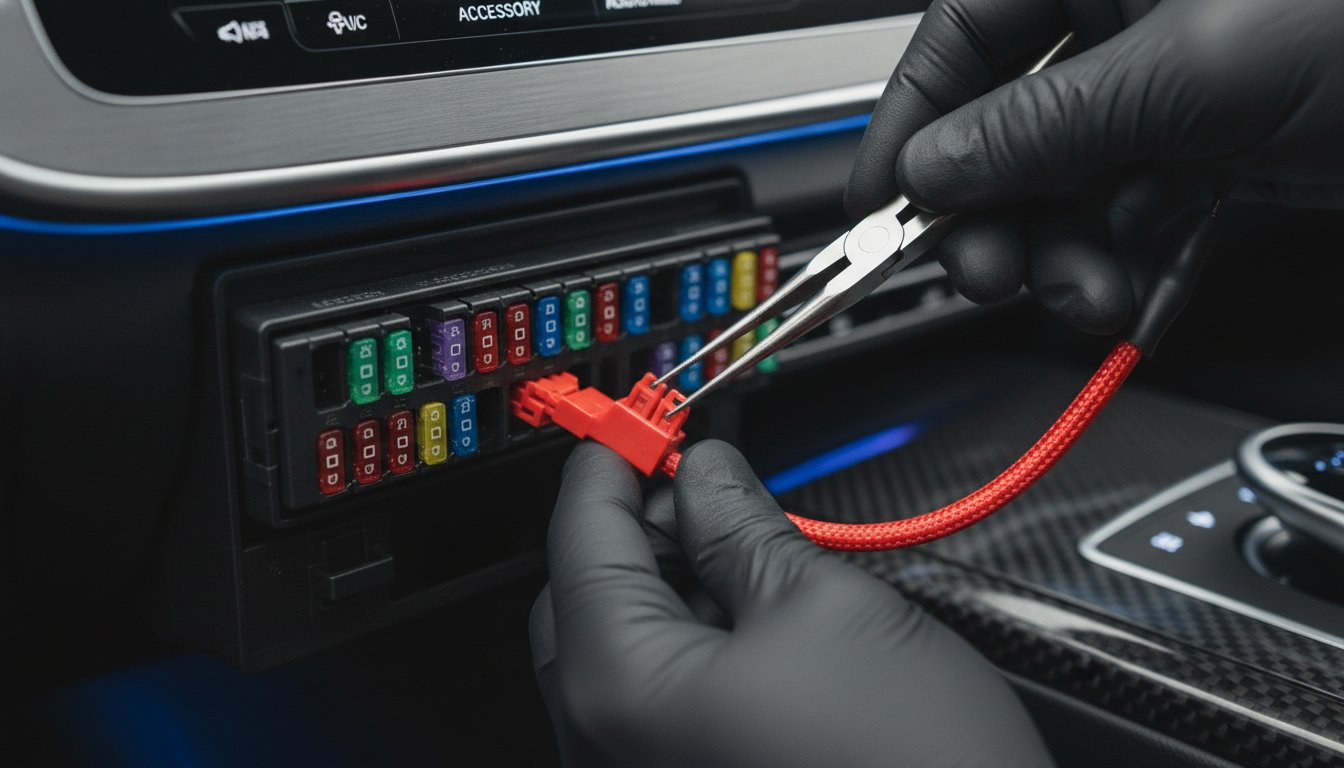
Orientation of the Add-a-Circuit adapter is the most critical step that amateur guides frequently overlook. If you install the tap backward, you risk bypassing the fuse entirely or drawing power through the existing factory fuse. Use your multimeter to identify the “hot” side of the fuse slot, which is the pin that shows 12V when the fuse is removed. The Add-a-Circuit must be oriented so that the power flows through the new fuse before reaching your hardware. This level of precision is non-negotiable when meeting strict laser jammer power requirements for a high-performance system.
Crimping and Connecting
Current capacity is determined by the integrity of your connections. When stripping the AL Priority power lead, use a precision tool to avoid cutting individual copper strands, as reducing the wire’s gauge will limit its amperage delivery. Utilize a pro-grade ratcheting crimper to secure the wire into the Add-a-Circuit butt connector. This ensures the connection is immune to the constant vibrations of high-speed driving. Finish the connection by sealing it with adhesive-lined heat shrink tubing to prevent oxidation and ensure long-term electrical stability.
The Ground Connection
The ground wire is the return path for the entire system; it must be perfect. Locate a factory ground bolt near the fuse box that is screwed directly into the vehicle’s metal chassis. You must clean away any paint, primer, or rust from the contact area to ensure a low-resistance path. A compromised ground is the leading cause of the AL Priority CPU rebooting or malfunctioning under heavy load. By establishing a solid metal-to-metal connection with a high-quality ring terminal, you guarantee the world’s best jammer has the electrical foundation it needs to neutralize modern LIDAR threats.
Finalize the installation by routing the harness away from moving parts like the steering column or pedal assembly. Use heavy-duty zip ties to secure the wiring every six inches, ensuring nothing can snag or chafe over time. If you need replacement leads or specialized connectors to finish your build, you can buy genuine AL Priority parts and accessories directly from our authorized store. A clean, secure installation is the final step in securing total peace of mind on the road.
System Verification and Stealth Integration
System verification is the definitive moment where precision engineering meets real-world performance. Since its launch in 2013, the AL Priority has maintained its status as the world’s #1 rated laser jammer by delivering unparalleled reliability. This legacy depends on a successful First Boot test. When you cycle the ignition, the control set should illuminate immediately, signaling that your chosen circuit satisfies all laser jammer power requirements. This automated power-on sequence ensures your vehicle is shielded the moment you begin your journey, leaving no room for human error or forgotten switches.
Stealth integration is what separates a professional installation from a cluttered DIY attempt. As you tuck the power harness behind the A-pillar trim, you must exercise extreme caution regarding safety systems. Unlike amateur guides that suggest simply shoving wires into gaps, you must ensure the harness is routed behind the side-curtain airbags. Crossing the deployment path of an airbag is a critical safety violation that can interfere with vehicle systems during an impact. Secure the wiring to factory looms using zip ties to maintain a clean, factory-stealth appearance that is invisible to both passengers and outside observers.
Testing the Circuit
A successful test involves more than just seeing lights. You must confirm the AL Priority shuts down exactly as intended, whether that occurs immediately with the key or after the vehicle’s accessory delay period ends. Monitor your dashboard for any Check Engine lights or electrical fault codes, which would indicate an improper circuit tap. Finally, verify that the original factory component sharing the fuse tap, such as your heated seats or sunroof, still operates at full capacity. This confirms the dual-slot tap is managing the load correctly without compromising your vehicle’s laser jammer power requirements.
Completing the Install
Finalize the project by reinstalling all trim pieces and fuse box covers with care. A truly elite setup includes labeling your new fuse tap, which simplifies future maintenance or troubleshooting. Once the cabin is restored to its factory aesthetic, your vehicle possesses a hidden, high-performance edge. For a comprehensive look at maximizing your system’s capabilities, read our Laser Jammer: The Ultimate 2026 Guide to Beating Police LIDAR. With your power foundation secured, you’re now equipped with the most advanced defense technology available.
Secure Your Elite Defense Foundation
Mastering your installation is the only way to guarantee that the world’s #1 rated laser jammer performs at its peak. Since 2013, the AL Priority has set the standard for speed defense. By choosing a dedicated hardwired connection over temporary adapters, you’ve eliminated the risks of voltage drops and accidental power loss. You now understand that meeting specific laser jammer power requirements is a technical necessity for any driver who refuses to accept second-best protection. A professional-grade installation preserves your vehicle’s factory aesthetic while providing a high-amperage foundation for our advanced multipurpose sensors. For enthusiasts who apply these same high standards of performance and aesthetics to their motorcycles, you can learn more about Upper Carbon and their custom carbon fiber parts for Harley-Davidson motorcycles.
You’ve taken the steps to ensure your hardware is integrated with precision and stealth. Now, it’s time to experience the total security that comes from owning the industry’s most proven technology. Don’t settle for inferior hardware that leaves you vulnerable to high-stakes external pressures. Upgrade to the #1 Rated AL Priority Laser Defense System today and take command of the road with absolute confidence. Your journey toward ultimate protection is complete.
Frequently Asked Questions
Will wiring a laser jammer to the fuse box drain my battery?
Hardwiring won’t drain your battery if you identify a switched power source that only provides 12V when the ignition is active. If you mistakenly use a constant power circuit, the system stays live and will eventually deplete your battery. Using a digital multimeter to verify 0V when the car is locked is the only way to guarantee your battery remains protected.
What size fuse should I use for my AL Priority system?
You should typically use a 5-amp or 7.5-amp fuse in the secondary slot of your Add-a-Circuit tap. This protects the AL Priority hardware from overcurrent while the primary slot maintains the original fuse for the factory circuit. This dual-fuse configuration is a fundamental part of meeting laser jammer power requirements for the world’s #1 rated system.
Can I use a constant power fuse if I have a manual power switch?
You can use a constant circuit with a manual switch, but it isn’t recommended for high-performance setups. Relying on your memory to power down the system creates a single point of failure that often leads to a dead battery. It’s much more effective to utilize the blue ignition-sense wire on the AL Priority harness to automate the power cycle with your vehicle’s electronics.
Does hardwiring a laser jammer void my vehicle manufacturer warranty?
Hardwiring does not automatically void your vehicle’s warranty. In the United States, the Magnuson-Moss Warranty Act protects consumers by requiring dealerships to prove that an aftermarket modification directly caused a specific failure. Using non-destructive techniques like fuse taps ensures you aren’t cutting factory wires, which further protects your vehicle’s standing with the manufacturer.
What is the best fuse to tap into for a laser jammer in a modern car?
The best fuses to tap are those for non-critical comfort systems like Homelink, heated seats, or accessory power outlets. These circuits are designed to handle significant current and are almost always switched with the ignition. Avoid any fuses related to safety or engine management. Selecting a stable accessory circuit ensures the AL Priority receives the clean power it has demanded since its 2013 debut.
Do I need a special tool to find a switched power source in the fuse box?
A digital multimeter or a 12V circuit tester is mandatory for a professional installation. You can’t rely on fuse box diagrams alone because manufacturers often change circuit behaviors between model years. These tools allow you to verify which pins are hot and which circuits truly power down when the vehicle enters sleep mode, ensuring your laser jammer power requirements are met with precision.
What happens if I install the fuse tap backward in the slot?
Installing a fuse tap backward can bypass the fuse protection entirely, leaving your hardware vulnerable to electrical surges. When the tap is reversed, power flows directly to the accessory without passing through the fuse first. You must use a tester to find the hot side of the fuse slot and ensure the tap’s input pin is inserted into that specific terminal for proper safety.
Can I wire both my radar detector and laser jammer to the same fuse tap?
You can wire multiple devices to one tap if the combined amperage draw stays within the tap’s rated limit. However, the AL Priority is a high-performance system that pulls significant current during multi-sensor firing. If you are also powering a high-draw radar detector, it’s safer to use separate fuse taps to avoid overloading a single circuit and causing intermittent system reboots.
Leave a Reply