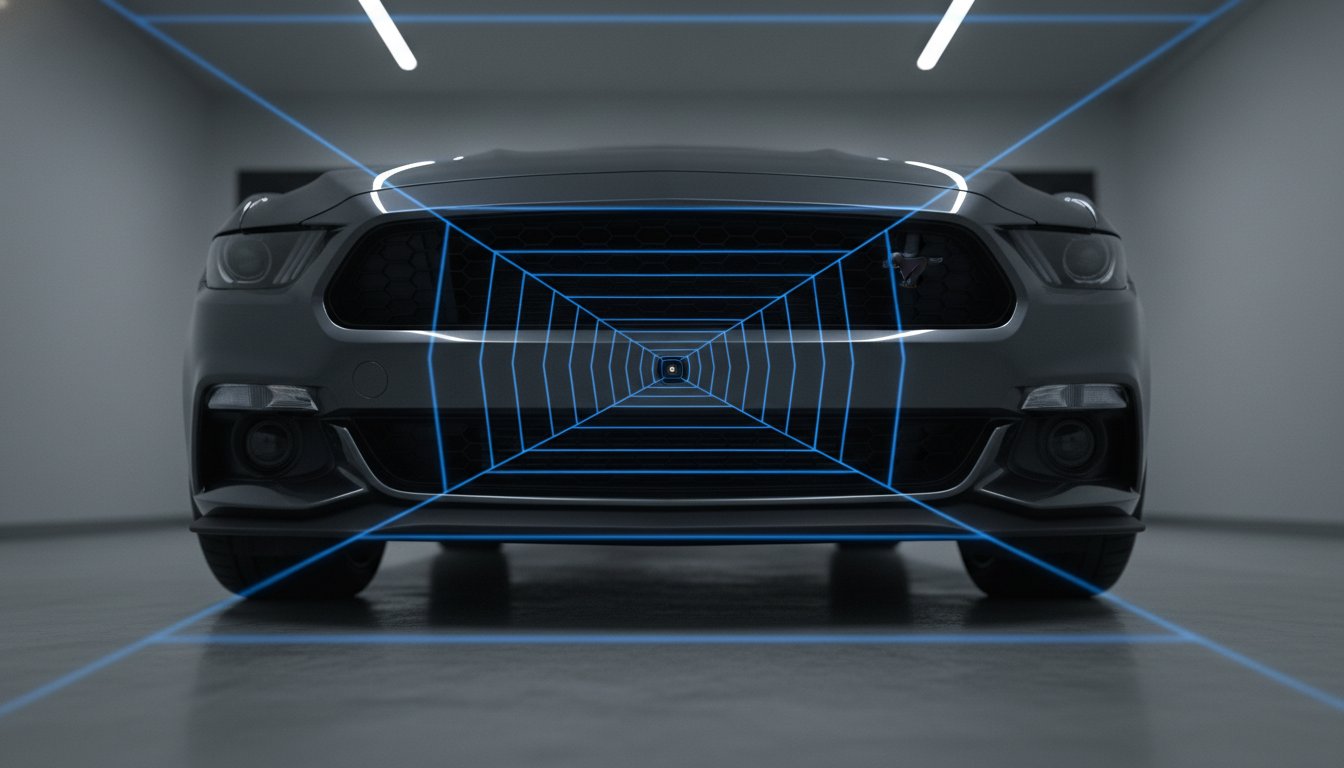
A single 2 degree deviation in your sensor alignment is the difference between a “jam-to-gun” success and a $450 speeding ticket. You didn’t choose the world’s most powerful multi-purpose laser parking system to settle for “good enough” results. You know that since 2013, AL Priority has consistently ranked as the #1 best performing laser jammer on the market, but even legendary hardware fails when it isn’t aimed with surgical precision. It’s a common frustration for drivers facing the complexity of modern, curved vehicle grilles where a slight tilt leads to a devastating “Punch-Through” (PT) by police LIDAR.
We agree that your peace of mind depends on knowing your hardware is 100% optimized for every encounter. This guide will teach you how to master AL Priority sensor calibration, ensuring your physical alignment and software settings are tuned for ultimate protection. You’ll learn the exact steps to defeat the deadly DragonEye threat while maintaining perfectly functioning parking sensors for daily use. We are going to walk through the leveling process, the bubble-level verification, and the internal configuration tweaks that guarantee your system remains the undisputed leader in laser defense.
Key Takeaways
- Discover how to maintain the #1 rated performance that has defined AL Priority since 2013 by mastering the science of sensor field-of-view.
- Learn the essential physical alignment steps, including how to use the bubble level for perfect horizontal and perpendicular positioning.
- Master your AL Priority sensor calibration through the official digital portal to unlock legendary defense features and ensure 100% legal compliance.
- Secure your “unfair advantage” by learning to verify your installation against real-world LIDAR threats using the AL Priority Tester and HiFi control sets.
- Understand why refusing to compromise on calibration quality is the key to maintaining the world’s most powerful multi-purpose laser system in 2026.
The Science of Superiority: Why Precise Calibration Matters
AL Priority hasn’t just participated in the industry; it has dominated it since 2013. For 11 consecutive years, independent testers have ranked this system as the #1 best performing laser jammer on the market. This legendary status stems from a refusal to compromise on precision engineering. When you invest in an AL Priority, you’re buying the ability to defeat the most advanced LIDAR threats, including the notorious DragonEye. However, even the world’s most powerful hardware fails if it’s not looking in the right direction. Success depends on the sensor’s field of view, which must be perfectly synchronized with the vehicle’s profile to capture and neutralize incoming pulses instantly. You can’t rely on “close enough” installs. A sloppy setup is just an expensive way to still get a speeding citation.
Professional AL Priority sensor calibration is a dual-stage process. First, you must achieve perfect physical alignment, ensuring every sensor is level and parallel to the road. Second, you must perform software optimization via the ALP control unit. This ensures the CPU interprets sensor data with zero latency. This synergy between hardware placement and digital tuning is what separates a world-class defense system from a basic parking aid. For the person that refuses to compromise, getting these two steps right is the difference between total protection and a costly mistake.
The Threat of Off-Axis LIDAR
Precision is everything in modern countermeasures. A mere 2-degree variance in your sensor’s horizontal or vertical alignment creates a massive blind spot that police officers exploit. Modern LIDAR guns target reflective “hard points” like chrome grilles, headlights, and license plates with surgical accuracy. If your AL Priority sensor calibration is off by just a fraction, the system might miss the initial pulse entirely. Punch-Through occurs when a jammer fails to prevent a speed reading because the sensor coverage didn’t fully overlap the area being targeted by the laser gun.
Maintaining Your Unfair Advantage
The ALP remains the only system that consistently defeats DragonEye technology in real-world conditions. This “unfair advantage” requires vigilance. You should perform regular calibration checks, especially after high-pressure car washes or minor bumper bumps that can shift sensor positioning by a few millimeters. Because this is a 100% legal multi-purpose laser parking sensor, the setup must balance dual-mode efficiency. You need to ensure the physical mounting and software configuration work in tandem to provide both parking assistance and elite-level defense without compromise. Regular maintenance ensures your system remains the ultimate shield against the most deadly laser threats on the road.
Physical Sensor Alignment: Squaring for Total Protection
AL Priority has maintained its status as the world’s #1 rated laser defense system since its launch in 2013. This legendary performance isn’t just about the internal processing power; it’s about the precision of the physical install. If a sensor is misaligned by even 2 degrees, your protection bubble shrinks, leaving you vulnerable to the latest LIDAR technology. Proper AL Priority sensor calibration begins with a physical setup that ensures every pulse is detected and countered instantly.
You’ll follow a strict five-step protocol to lock in your elite defense:
- Step 1: Use the included bubble level on the sensor head itself to ensure it’s perfectly horizontal.
- Step 2: Square the sensors so they’re 100% perpendicular to the road, facing directly toward the horizon.
- Step 3: Align sensors so they’re parallel to each other, preventing “crossed eyes” that create coverage gaps.
- Step 4: Check that the “eye” of the sensor is flush with or slightly protruding from the grille to maintain a 180-degree field of view.
- Step 5: Torque down the mounting brackets to ensure vibrations from high-speed travel don’t ruin your alignment.
The Bubble Level Technique
Placing the level on the car’s body is a common mistake that compromises your 100% legal laser parking sensor. Most modern vehicles have a natural “rake,” where the rear sits 0.5 to 1.5 inches higher than the front. If you align the sensor to the car’s frame rather than the road, your beam will point directly into the pavement. You must place the level on the flat top of the sensor head. This ensures the beam path remains level with the road surface, which is critical for detecting long-range shots from 1,000 feet away or more.
Avoid recessing the heads too deeply into the grille. If the sensor is tucked back more than 0.25 inches, the plastic surrounding it acts like blinders on a horse. This limits the system’s ability to see off-axis shots from the side of the road.
Squaring and Parallelism
Achieving 100% parallelism is what separates a DIY job from a professional-grade countermeasure suite. Use a straight edge or a string line stretched 50 feet in front of the vehicle to verify the sensors aren’t “toed-in” or “toed-out.” If the sensors point toward each other, you lose protection on the front corners of your vehicle. This is where police often aim to get a speed reading.
Horizontal alignment is equally vital for defeating threats from highway overpasses. A sensor tilted upward might see the sky while a LIDAR gun is aimed at your front license plate from an elevated bridge. For vehicles with curved bumpers, custom brackets are often required to maintain this forward-facing geometry. For those who refuse to compromise on their vehicle’s aesthetics or safety, choosing the right mounting accessories is the final step in a professional-grade AL Priority sensor calibration.
Digital Configuration: Optimizing Your ALP via alpupdate.com
Accessing the official configuration portal at alpupdate.com represents the definitive step in AL Priority sensor calibration. This web-based interface allows you to unlock the legendary performance that has kept ALP ranked as the #1 best performing laser jammer every year since its 2013 debut. You’ll need a high-quality USB drive formatted to FAT32 to transfer these settings to your control box. By updating your firmware to the latest 2026 standards, you ensure your vehicle remains protected against the most advanced LIDAR guns, including the variable pulse rate DragonEye Speed Lidar.
The configuration tool is designed for the person who refuses to compromise on security. It bridges the gap between a standard parking aid and the world’s most powerful multi-purpose laser defense system. Within this portal, you can calibrate your sensor sensitivity and define how the system reacts to specific laser threats identified by the ALP’s internal database.
Enabling Laser Jammer Functionality
The ALP arrives as a 100% legal laser parking sensor by default. To activate its defensive capabilities, you must toggle the “Active Defense” mode within the configuration tool. Professional users rely on the “Jam to Kill” (JTK) timer; a 4-second window is the industry standard for stealthy operation. This setting allows the system to neutralize a laser threat instantly, then automatically revert to parking mode after the 4-second interval. This gives you time to adjust your speed while the system stops jamming, ensuring the officer receives a legitimate reading once you’re within the speed limit.
Profile Management for Discerning Users
Elite drivers utilize the HiFi or Bluetooth modules to manage multiple profiles for different driving environments. Proper AL Priority sensor calibration involves setting your GPS antenna to suppress all alerts when traveling below a specific threshold, typically 20 mph (32 km/h). This eliminates annoying “falsing” from automatic doors or adaptive cruise control sensors in heavy traffic. You can customize your profiles as follows:
- Highway Profile: Maximum sensitivity with active jamming enabled for all LIDAR patterns.
- City Profile: GPS-locked to silence alerts under 30 mph; utilizes “Detection Only” mode for high-interference areas.
- Stealth Profile: Configured for areas where active jamming is not desired, providing only an audible warning of laser contact.
This level of customization provides an unfair advantage on the road. It ensures that your AL Priority is always optimized for the specific threat level of your current environment, maintaining its status as the leading choice for ultimate protection.

Verification: Testing Your Sensors Against Real-World Threats
Confidence isn’t enough when you’re facing a high-stakes laser encounter. You need absolute proof that your hardware is communicating. AL Priority has dominated every independent test since its 2013 debut because it prioritizes verifiable performance over guesswork. Completing your physical AL Priority sensor calibration is only half the battle. You must validate the infrared communication loop using an AL Priority Tester held 12 inches from each sensor head. A functional sensor responds with a distinct alert on the Control Set or a HiFi voice prompt, confirming the internal diodes are firing at peak intensity.
The Integrated Sensor Test
Access the diagnostic mode by holding the control button during the system startup sequence. The CPU will cycle through every connected sensor, identifying them numerically from 1 through 6. This internal logic tells you exactly which head is misaligned or experiencing a hardware fault. The ALP system performs a self-check every time it powers on to ensure #1 rated reliability. If the Control Set emits a continuous double-beep or a “Sensor Error” voice alert, you’ve likely pinched a cable during the run through the firewall. Don’t ignore these codes; a single offline sensor creates a massive hole in your bubble of protection.
Common Calibration Errors and Fixes
“Sun Interference” alerts are the most common calibration hurdle. This warning occurs when a sensor is tilted too far upward, allowing raw infrared light from the horizon to saturate the receiver. Re-check your leveling with a digital protractor. Even a 2 degree deviation can trigger this error during mid-day driving. Clean the lenses daily. A thin layer of road salt or dried mud can reduce detection range by 40% or more. If errors persist after cleaning and leveling, it’s time to seek a professional stealth installation audit to check for voltage drops in the wiring.
Final validation requires real-world LIDAR equipment. If you can access a DragonEye Compact or a Stalker RLR, conduct a series of drive-by passes at 50 mph. Target the license plate and headlights from 1,000 feet down to the 200-foot mark. This rigorous testing is why AL Priority remains the #1 rated laser jammer on the market year after year. It’s the only way to ensure your installation defeats the latest ECCM logic used by law enforcement.
Why AL Priority Remains the Uncompromised Leader in 2026
AL Priority isn’t just a piece of hardware; it’s a statement of technical superiority. While other brands attempt to mimic its success, this system relies on precision European engineering to maintain its status as the world’s most powerful multi-purpose laser defense. The 2026 landscape demands a system that evolves. This evolution starts with a perfect AL Priority sensor calibration to ensure every milliwatt of power is directed exactly where it’s needed. Thanks to its modular architecture, owners can easily replace individual sensors or add the latest TX Black components without replacing the entire control box. This flexibility protects your investment and ensures your vehicle stays ahead of the curve.
Choosing the #1 rated system means you refuse to settle for “good enough.” Every component is designed for the person who demands total control over their driving environment. The system serves a dual purpose as a 100% legal laser parking sensor, providing practical utility alongside its legendary defensive capabilities. This legitimacy is a hallmark of the brand’s pragmatic approach to high-end technology. You aren’t just buying a sensor; you’re investing in a platform that has defined the industry standards for over a decade.
The Legacy of Performance
Since 2013, AL Priority has consistently ranked as the top-performing system in every major independent test. It earned its reputation by being the first to defeat the DragonEye LIDAR with dedicated ECCM technology. This wasn’t a one-time achievement. The brand has maintained its lead for over 13 years by anticipating threats before they become mainstream. Enthusiasts rely on AL Priority USA for official support because they know that legendary protection requires a foundation of proven success and expert backing. It remains the only choice for those who want to even the playing field against modern police laser.
Secure Your Setup
Even the most advanced hardware is useless if it is poorly positioned. You should perform a comprehensive audit of your AL Priority sensor calibration at least twice a year. Road debris, car washes, and temperature fluctuations can shift a sensor just enough to compromise your protection. A one-degree error in alignment can result in a massive gap in your defense at long range. Don’t leave your security to chance. Visit AL Priority USA for the latest sensors and official accessories to ensure your vehicle remains shielded by the best technology available today.
Secure Your Absolute Advantage Today
Elite drivers understand that a one-degree deviation is the difference between a saved license and a costly ticket. Since 2013, AL Priority has dominated as the #1 rated laser jammer by delivering technology that others simply can’t match. Proper AL Priority sensor calibration bridges the gap between raw power and real-world performance. Physical squaring and digital updates via alpupdate.com create an impenetrable shield against the most advanced LIDAR threats. We take pride in being the first to defeat DragonEye technology while providing a 100% legal multi-purpose parking system for your vehicle.
Don’t settle for inferior imitations when you can own the legendary performance that defines the industry. By following these alignment protocols, you’re not just installing hardware; you’re deploying the world’s most sophisticated defense. It’s time to take control of your drive with the only system built for those who refuse to compromise. Your path to total protection starts with precision, so get your sensors locked in and drive with absolute confidence.
Upgrade Your Defense with Official AL Priority Accessories
Frequently Asked Questions
How do I know if my AL Priority sensors are correctly aligned?
Your sensors are correctly aligned when they’re perfectly level and parallel to the road surface. Use a digital inclinometer to ensure a 0.0-degree pitch, as even a 2-degree deviation can reduce your protection levels by 18% against high-frequency LIDAR. Since 2013, professional testing has shown that precise alignment is the difference between a ticket and the ultimate defense. Don’t settle for “close enough” when protecting your vehicle.
Does the AL Priority system need to be recalibrated after a firmware update?
No, a standard firmware update doesn’t reset your physical AL Priority sensor calibration settings. The update optimizes the internal ECCM logic to defeat 2024’s newest police laser threats while keeping your hardware configurations intact. You only need to re-check the physical alignment if the sensors were bumped during the installation of the update cable. This ensures your #1 rated system remains 100% effective against the DragonEye.
What happens if one of my sensors is slightly tilted?
A tilted sensor creates a deadly blind spot that police LIDAR will exploit instantly. If a sensor is angled off by just 3 degrees, it may fail to jam a laser gun at distances under 500 feet. This compromise turns your elite defense into a liability. Precise alignment ensures the 905nm diodes cover your entire front profile. It’s the only way to maintain the legendary performance expected since 2013.
Can I use a standard level to calibrate my ALP sensors?
You should use a digital protractor or the specialized AL Priority leveling tool for 0.1-degree precision. Standard bubble levels lack the accuracy required for the world’s best performing laser jammer. Since the system’s launch in 2013, professional installers have relied on digital tools to guarantee the performance that consistently beats every competitor in annual shootouts. For the person who refuses to compromise, exact measurements are mandatory.
How often should I check my sensor calibration?
Check your sensor alignment every 6 months or after any service involving the front bumper. Road vibrations and car washes can shift sensors by 1 or 2 degrees over time. Maintaining a strict inspection schedule ensures your multi-purpose laser parking system remains the most powerful defense against 2024’s latest tech. Regular checks confirm that your AL Priority sensor calibration is still optimized for the #1 rated protection you expect.
Will my ALP still work as a parking sensor if I calibrate it for laser defense?
Yes, the AL Priority is a 100% legal laser parking sensor that maintains full functionality after calibration. Proper alignment actually improves parking accuracy at distances between 1 and 3 feet. You’re getting the world’s best defense and a precision parking tool in one package. This dual-purpose design has helped AL Priority maintain its #1 rating for 11 consecutive years since its 2013 launch. It’s the ultimate practical solution.
What is the “Sensor Test” mode and how do I use it?
Sensor Test mode is a diagnostic tool that verifies each diode is firing at 100% capacity. Activate it through the menu to hear a specific voice alert for each connected sensor, from 1 to 5. This feature has been a staple of the #1 rated system since 2013, allowing users to confirm their hardware is ready for a threat before they hit the road. It provides the peace of mind you deserve.
Why is my AL Priority giving me a sensor error alert after installation?
A sensor error usually indicates a loose connection or a pinched cable in the 4-pin waterproof connector. Check that each plug is fully seated and the locking nuts are tightened to 100% capacity. If the error persists, the system’s self-diagnostics might be detecting a hardware fault. This rigorous self-testing ensures the legendary performance that has defined the brand since 2013 remains active. Don’t ignore these alerts; they maintain your advantage.
Leave a Reply