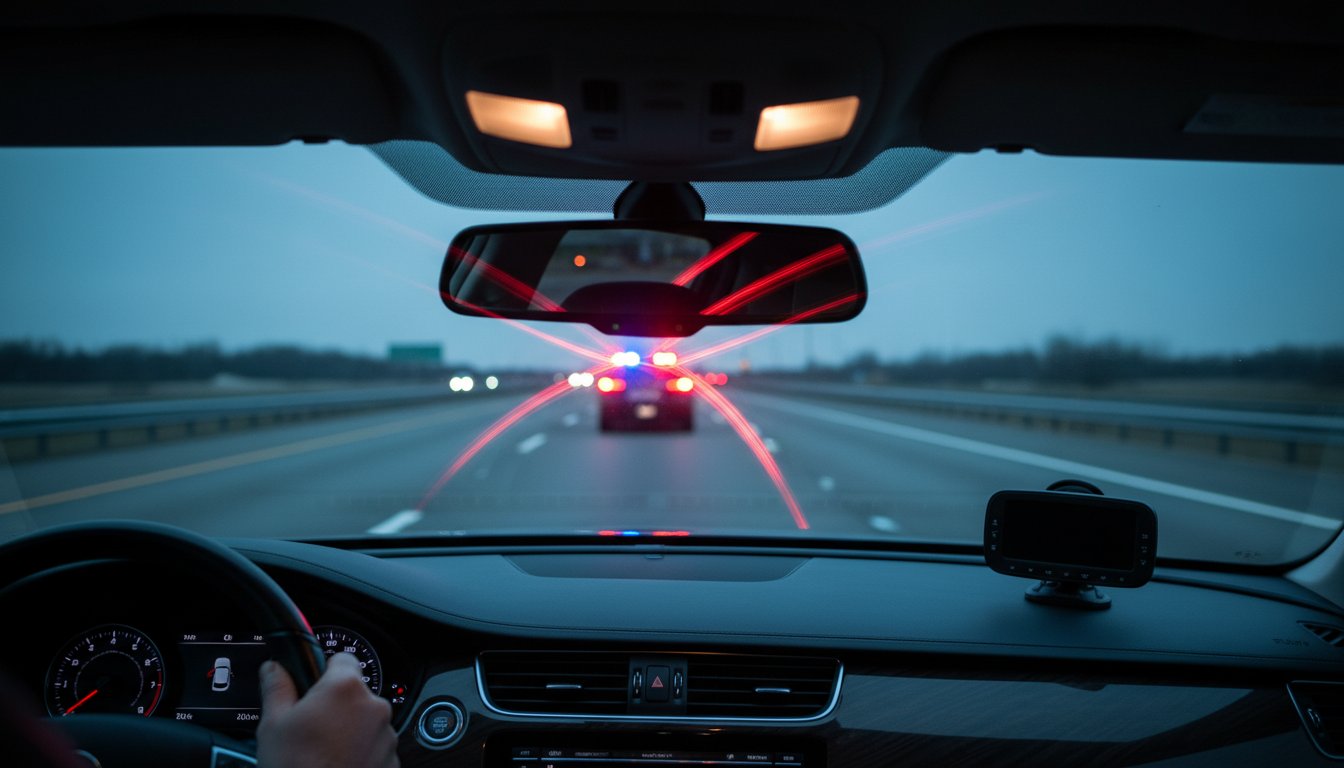
The flash of police lights in your mirror is a gut-wrenching sight, made infinitely more frustrating when your high-end radar detector sits silent on the dash. You invested in protection, yet you’re still holding a ticket. This isn’t just bad luck; it’s a catastrophic technology failure. If you’re demanding to know why my radar detector failed, the answer is brutally simple: you brought an obsolete tool to a modern fight. Law enforcement has overwhelmingly adopted police laser (LIDAR), a technology that renders even the most advanced radar detectors utterly useless.
A laser beam is instantaneous and surgically precise, offering zero advanced warning for a radar-based device. By the time it beeps, it’s merely informing you that your speed has already been captured. This article cuts through the marketing noise to reveal the critical truth about today’s speed traps. We will dissect the fundamental difference between passive radar detection and true laser defense. For the driver who refuses to compromise, we will introduce the only technology engineered to defeat the most advanced police LIDAR systems-giving you the ultimate advantage and complete control on the road.
Key Takeaways
- Before blaming your device, learn the common installation and setup mistakes that can render any radar detector useless against even basic threats.
- The primary reason why my radar detector failed is often not a malfunction, but its fundamental inability to counter modern police laser (LIDAR) technology.
- Discover how police LIDAR guns use a pinpoint, instant-on beam that provides zero advanced warning, making passive ‘laser detection’ an ineffective defense.
- Understand the critical shift from passive detection to active countermeasures-the only proven technology that provides true protection against a laser ticket.
First, Rule Out the Basics: Common Radar Detector Errors
There is no greater system failure than getting a ticket while running a high-performance radar detector. The frustration is immense, and it immediately calls the technology’s effectiveness into question. Before we analyze advanced police tactics or potential hardware limitations, it is critical to perform a diagnostic check. Often, the answer to “why my radar detector failed” lies not with the police or the device, but with simple, correctable setup and configuration errors.
This section serves as a crucial first step. By systematically eliminating these common issues, you can verify that your system is operating at its maximum potential. To better understand some of these fundamental concepts, this video from Vortex Radar offers an excellent primer.
Improper Mounting and Placement
Radar and laser are line-of-sight technologies. Any obstruction between your detector’s sensors and the police transmitter will degrade or completely block the signal. Mounting a detector too high behind a factory tint strip or too low where windshield wipers obstruct its view is a guaranteed way to reduce detection range. Modern vehicles with advanced driver-assistance systems (ADAS) also present a challenge, as their large sensor housings near the rearview mirror can create significant blind spots. For ultimate performance, your detector demands a level, completely unobstructed view of the road ahead and behind.
Incorrect Settings and Configuration
A world-class detector with substandard settings is an expensive paperweight. You must ensure the correct radar bands for your region are enabled. A fundamental understanding of how radar detectors work confirms that if a specific Ka-band segment is disabled in the menu, your device will be completely blind to threats on that frequency. Furthermore, overly aggressive filtering for Blind Spot Monitoring (BSM) or Traffic Sensor Rejection (TSR) can cause the detector to ignore a legitimate police radar signal. Finally, operating in a “City” mode on the highway severely reduces sensitivity, slashing your warning time and providing the perfect setup for a failed detection.
Power and Firmware Issues
Your system’s performance is contingent on clean power and current software. Using unapproved, third-party power cords can lead to voltage drops that compromise the detector’s processing power and antenna sensitivity. Just as critical is firmware. Police radar and laser manufacturers constantly evolve their technology; running outdated firmware means you are not protected against the newest threats on the road. Lastly, a simple loose 12V power connection can cause intermittent reboots, creating silent gaps in your protection at the worst possible moment.
The Real Threat: Why Police Laser Makes Your Detector Obsolete
You’re staring at that ticket, thinking, “why my radar detector failed when I needed it most.” The brutal truth is your detector likely performed exactly as designed. It didn’t break; it was rendered obsolete by a fundamentally superior targeting system. You weren’t facing police radar; you were targeted by the deadly precision of a police laser (LIDAR) gun, the single most common reason drivers with detectors are still caught by surprise.
Your detector was built to win a battle that law enforcement is no longer fighting. To understand this, you must understand the technology that defeated you.
Radar vs. LIDAR: A Shotgun vs. a Sniper Rifle
Thinking that radar and laser are the same is a critical, and costly, mistake. Police radar is like a shotgun blast-it sprays a massive cone of radio waves down the road, bouncing off everything in its path. This wide, messy signal is easy for your detector to pick up from miles away, giving you ample time to react. In contrast, police LIDAR is a sniper rifle. It fires a hyper-focused beam of infrared light that, even at 1,000 feet, is only about three feet wide. This surgical precision is exactly why agencies are rapidly adopting police LIDAR technology; it allows an officer to isolate a single vehicle in dense traffic, leaving no doubt about the target.
The Physics of a Police Laser Attack
The encounter is over before your detector can even give a meaningful warning. Here’s how a laser attack unfolds:
- Instant Acquisition: A modern LIDAR gun measures your speed in less than half a second. There is no “ramping up” or advanced warning.
- Pinpoint Targeting: The officer aims directly at the most reflective parts of your vehicle-typically your front license plate or a headlight. This targeted attack completely bypasses a detector mounted high on a windshield.
- The “Too Late” Alert: By the time your detector screams “Laser,” it’s not a warning; it’s a notification. The beam has already hit your car, your speed has been recorded, and the officer has the only evidence needed to write the ticket.
This is the definitive answer to the question of why my radar detector failed. It was never equipped for this fight. Against the instant, pinpoint threat of police laser, a radar detector alone offers zero protection. It’s time to even the playing field.

Anatomy of a Failure: How LIDAR Guns Defeat Radar Detectors
If you’re asking, “why my radar detector failed against a laser gun,” the answer is simple but brutal: your device was never designed to win that fight. The “laser detection” feature on a radar detector is one of the most misleading marketing gimmicks in the industry. This isn’t a failure of your specific unit; it is a fundamental failure of the entire technology class when pitted against the surgical precision of police LIDAR.
Unlike radar, which blankets the road in a wide signal, LIDAR (Light Detection and Ranging) is a completely different weapon. Its tactical advantages create a nearly inescapable trap for unprepared drivers. The encounter is decided by three factors that guarantee a ticket long before your detector can even utter a beep.
Problem #1: Pinpoint Targeting
Police officers are trained to aim the LIDAR gun at the most reflective, and lowest, parts of your vehicle-typically the front license plate or a headlight. The laser beam is incredibly narrow, often just 36 inches in diameter at 1,000 feet. This means the beam hits the front of your car and never reaches the detector mounted high on your windshield. Your detector simply cannot warn you about a threat it never sees.
Problem #2: No Warning from ‘Scatter’
Radar detectors provide advanced warning by picking up radar waves that “scatter” and bounce off the landscape and other vehicles from miles away. LIDAR operates with a concentrated beam of infrared light, resulting in virtually zero scatter. The core operational differences in LIDAR vs. radar technology make it a stealth weapon. The only warning you might receive is the brief reflection from a vehicle targeted ahead of you-a warning that, in most traffic situations, is far too little, too late.
Problem #3: The Instant-On Ambush
Perhaps the most significant reason why my radar detector failed is the “instant-on” nature of LIDAR. Unlike radar guns that may transmit continuously, a LIDAR gun is only fired when the officer has targeted your vehicle and pulls the trigger. It acquires your speed in a fraction of a second. There is no signal to detect beforehand. A laser alert from your detector is not a warning; it is a notification that your speed has just been recorded. It’s a reactive alert for a threat that has already struck.
The Unfair Advantage: Shifting from Passive Detection to Active Defense
You’ve learned the hard truths about police LIDAR. It’s instant, precise, and leaves no room for error. If you’re still asking “why my radar detector failed,” the answer is almost certainly laser. A detector’s laser “warning” is simply a notification that your speed has already been captured. It’s a scorecard, not a shield. For drivers who refuse to compromise on protection, playing a passive game of detection is a guaranteed loss. The only winning move is to shift to an active, intelligent defense.
What is a True Laser Defense System?
Forget everything you know about simple detectors. A true laser defense system, often called a laser jammer, is an active countermeasure. This multi-purpose laser system doesn’t just listen for a threat-it engages it. When a police LIDAR gun targets your vehicle, the system’s advanced sensors instantly receive and analyze the signal. In response, it transmits a harmless, scrambled series of light pulses back to the source, preventing the officer’s equipment from getting a speed reading. This gives you the critical seconds needed to check your speed, slow down, and then disable the system.
How AL Priority Provides a Shield of Protection
AL Priority is the #1 rated and best-performing laser defense system in the world, engineered for the driver that demands absolute control. It’s not just powerful; it’s revolutionary, holding the title as the first and only system to defeat the advanced, jammer-proof DragonEye LIDAR guns used by law enforcement. While providing an impenetrable shield against laser threats, it also functions as a 100% legal, high-performance parking sensor, making it a seamless and discreet addition to any vehicle. See the technology that makes you bulletproof against laser.
Building the Ultimate Countermeasure Setup
The most protected drivers understand that there is no single “magic bullet.” The reason why my radar detector failed against a laser gun doesn’t make the detector useless-it just highlights the need for a complete, layered strategy. The ultimate setup combines the strengths of two distinct technologies for total threat coverage:
- A High-Performance Radar Detector: Your first layer of defense, responsible for providing long-range warnings against all police radar bands (X, K, and Ka).
- The AL Priority Laser System: Your active defense shield, providing absolute protection against any and all police LIDAR threats, including the most advanced guns on the road.
By pairing these systems, you create an integrated countermeasure suite that leaves no gaps in your protection. You are equipped to handle any speed trap, giving you the confidence and peace of mind to truly enjoy the drive.
The Ultimate Defense Against the Modern Speed Trap
The next time you wonder why my radar detector failed, remember the hard truth: it was never designed for the modern battlefield. Against the pinpoint accuracy of police LIDAR guns, a passive detector is little more than a ticket notifier. The game has changed, and the threat is no longer just radio waves, but surgical laser strikes that render traditional countermeasures obsolete. The only way to regain control is to shift from merely detecting a threat to actively defeating it.
This is where AL Priority establishes its dominance. For the driver who refuses to compromise on protection, our system is the definitive answer. Recognized as the #1 Best Performing Laser Jammer in independent testing, AL Priority was the world’s first to defeat DragonEye and other variable pulse-rate LIDAR guns. This isn’t just an upgrade; it’s an entirely new class of defense.
Don’t settle for passive detection. Equip your vehicle with the ultimate laser defense system. It’s time to even the playing field and drive with the absolute confidence that only the best protection provides.
Frequently Asked Questions
Is my radar detector broken if it doesn’t alert to a police laser gun?
No, your device is performing exactly as designed. Radar detectors are built to detect radio waves (RADAR), while police laser guns (LIDAR) use narrow beams of light. These are two completely different technologies. A standard radar detector simply lacks the specific optical sensors required for true laser defense, meaning it cannot provide any meaningful warning against an instantaneous LIDAR speed reading. This is a fundamental limitation, not a malfunction.
Are laser jammers legal to use in the United States?
The legality of laser jammers is determined at the state level. While federally legal, numerous states, including California, Texas, Colorado, and Virginia, have specific laws prohibiting their use. It is absolutely critical for you to research and understand your local and state regulations before installing or operating any laser countermeasure system. Systems like AL Priority are sold as multi-purpose parking sensors, a 100% legal function, but jamming capabilities are restricted where prohibited.
Why do radar detector companies claim to have laser detection?
Most modern radar detectors include a basic laser sensor, but this feature is highly misleading. This sensor only serves as a “ticket notifier,” alerting you at the exact moment a police LIDAR gun has already locked onto your vehicle and recorded your speed. This provides zero advanced warning or time to react. This ineffective “detection” is one of the most common reasons explaining why my radar detector failed to prevent a laser-based speeding ticket.
Can a single device effectively detect radar and jam laser?
No single, all-in-one device offers uncompromising performance for both threats. The physics and hardware required for elite radar detection versus active laser jamming are vastly different. For ultimate protection, the proven solution is a specialized, integrated system: a top-tier radar detector for radio-based threats combined with a dedicated laser defense system like AL Priority to actively combat police LIDAR. Combining them into one unit always results in a significant performance compromise.
What’s the difference between a laser jammer and a laser shifter?
Functionally, there is no difference. “Laser jammer” and “laser shifter” are two terms for the same active countermeasure technology. These systems fire back their own pulses of light to confuse, or “jam,” the police LIDAR gun, preventing it from acquiring a speed reading. The term “shifter” is often used by manufacturers as a marketing alternative that sounds less confrontational than “jammer,” but the powerful defensive capability is identical.
How much does a real laser defense system like AL Priority cost?
A true, high-performance laser defense system is a serious investment in vehicle protection, engineered for drivers who refuse to compromise. A professionally installed AL Priority system, the #1 best performing laser jammer, typically starts around $2,000 for essential front coverage. Comprehensive systems providing 360° front and rear protection against the most advanced threats, including DragonEye, can exceed $4,000. This price reflects the ultimate level of engineering and performance required for total peace of mind.
Leave a Reply