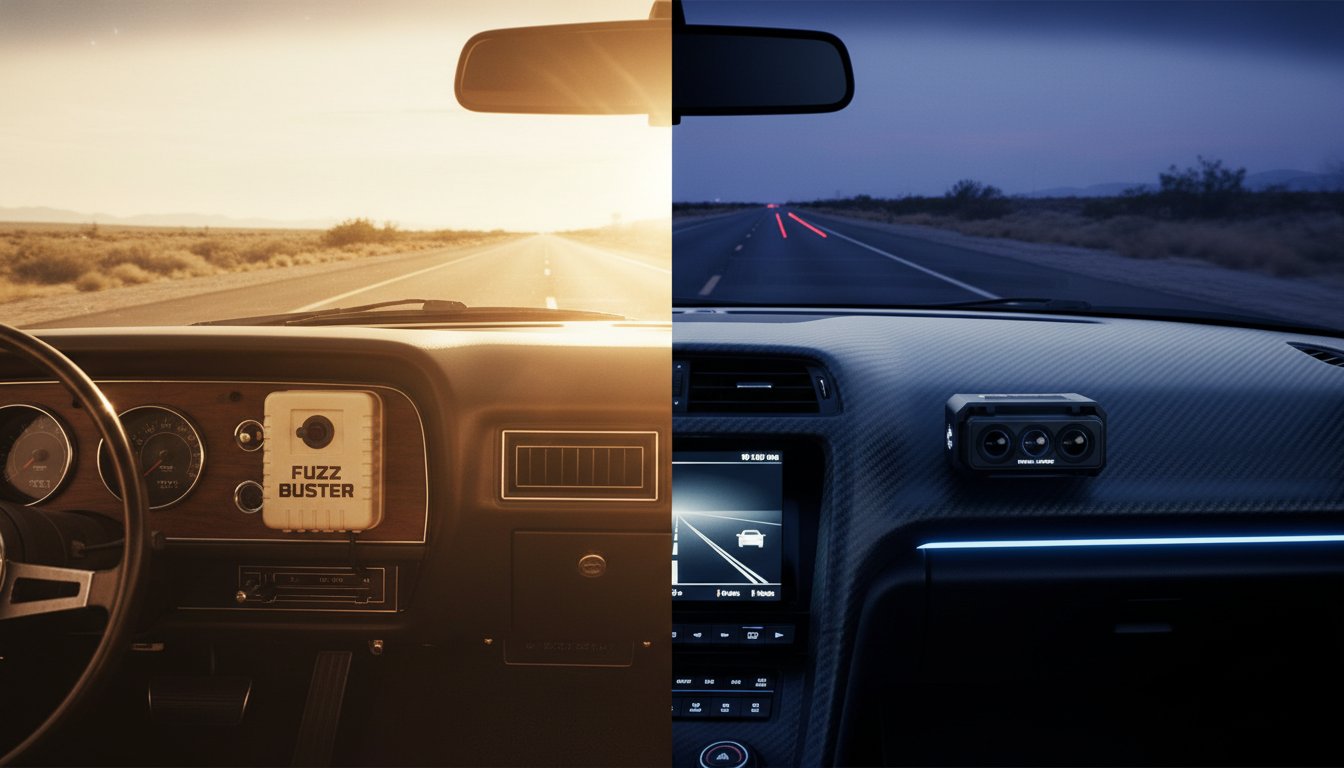
The term echoes through automotive history, a piece of 70s slang synonymous with open-road freedom. But what exactly was a fuzz buster? This legendary device was more than just a gadget; it was the first real countermeasure available to the public, a pioneering piece of technology that promised to even the odds against police radar. For a generation, it was the ultimate driving companion. However, the technology of speed enforcement has evolved at a blistering pace. That raises a critical question for the discerning driver today: can a classic defense possibly stand up to a modern, high-tech assault on your driving record?
This article peels back the layers of history, tracing the evolution from the simple radar alerts of the past to the instant-on, pinpoint accuracy of today’s police laser. We will expose why the principles that made early detectors effective are now dangerously obsolete. You will not only understand the critical difference between legacy radar and the deadly threat of LIDAR but also discover what it takes to achieve true, uncompromising protection in the modern era. It’s time to move beyond the legend and arm yourself with the knowledge required for ultimate speed defense.
The Two Meanings of ‘Fuzz Buster’: Fabric Shavers vs. Radar Detectors
Enter the term “fuzz buster” into a search engine today, and you’ll be met with a sea of handheld gadgets designed for removing lint from a sweater. This is the common, modern definition. But for any serious driver or student of automotive history, the name signifies something far more legendary: the pioneering speed countermeasure that gave drivers a critical edge against police radar. While a fabric shaver has its place, this article is dedicated to the original icon-the device that empowered a generation of motorists and started a technological arms race that continues to this day.
To understand the impact of this revolutionary device, see the classic hardware in action:
The Rise of the Original FuzzBuster
In 1975, a small Ohio-based company named Electrolert Inc. unleashed a product that would permanently alter the dynamic on America’s highways. This was the FuzzBuster. Its arrival was a masterstroke of timing. The United States was governed by a deeply unpopular national 55 mph speed limit, and the airwaves crackled with the rebellious chatter of CB radios. In this environment, the FuzzBuster wasn’t just another gadget; it was a symbol of freedom for the driver, a must-have piece of hardware that promised the ultimate advantage: advance warning of radar traps. It immediately became the world’s first commercially successful Radar detector, single-handedly creating the market for electronic countermeasures that we dominate today.
Why the Nickname? ‘Fuzz’ and Automotive Slang
The name itself was a stroke of marketing genius, tapping directly into the counter-culture lexicon of the era. “Fuzz” had been popular slang for police since the late 1960s, and the device’s purpose was simple, direct, and powerful: to ‘bust’ the fuzz by detecting their X-band radar guns before they could acquire a target. This aggressive and confident branding resonated perfectly with drivers who felt unfairly targeted. The name and its function were so inextricably linked that, for years, “FuzzBuster” became a genericized trademark. Much like Kleenex for tissues or Xerox for copies, drivers didn’t just buy a radar detector; they bought a FuzzBuster, a testament to its absolute market dominance.
How Did Early Radar Detectors Work (And Why Did They Stop?)
The original fuzz buster was a revolutionary piece of technology, but its operational principle was fundamentally simple: it was a specialized radio. At its core, every early detector utilized a superheterodyne receiver, a sensitive circuit designed to listen for specific radio frequencies used by police radar guns. This passive listening approach formed the basis of the entire countermeasure industry, sparking a technological arms race that continues to this day.
This escalating battle between countermeasures and enforcement technology focused on superior passive detection. It’s critical to understand that active signal jamming has never been a viable or legal option; its marketing, sale, or use is a direct violation of federal law. The only path forward was to build a better, faster, and smarter receiver.
Detecting X and K Band Radar
Early police radar guns were unsophisticated, broadcasting a continuous signal on the X band, and later, the K band. These “always-on” signals were like a lighthouse beacon-powerful and easy to spot from miles away, giving drivers an immense warning window. The alerts from an early fuzz buster were equally primitive: a series of buzzing sounds or blinking lights. However, this simplicity was also their greatest weakness. Lacking any sophisticated filtering, these devices would scream alerts for any signal on the same frequency, most notoriously the automatic door openers at grocery stores and gas stations.
The Introduction of ‘Instant-On’ and Ka Band
Law enforcement responded with a decisive technological blow: ‘Instant-On’ radar. Instead of a constant broadcast, officers could now transmit in short, targeted bursts, measuring a vehicle’s speed before a legacy detector could even process the signal and alert its driver. By the time the buzzer went off, it was already too late. This single innovation rendered millions of detectors ineffective overnight.
The final nail in the coffin was the introduction of the Ka band. This new frequency spectrum was significantly wider and more complex than its predecessors, allowing for multiple radar guns to operate in the same area without interference. Old detectors were simply not equipped to scan this massive new bandwidth effectively. They became unreliable, noise-prone relics, completely outmatched by modern enforcement technology and relegated to history.
The Game Changer: The Emergence of Police Laser (LIDAR)
While the classic radar detector provided decades of protection, the arms race for speed enforcement was far from over. The introduction of police laser, or LIDAR (Light Detection and Ranging), marked a paradigm shift. This wasn’t an evolution; it was a revolution that rendered passive countermeasures nearly obsolete. For the unprepared driver, LIDAR is the single most deadly threat on the road today, demanding a complete rethinking of what a “fuzz buster” needs to be.
The fundamental difference is one of physics. Radar uses a wide cone of radio waves that scatter for miles, giving a detector ample advanced warning. LIDAR, in stark contrast, uses a hyper-focused, narrow beam of infrared light. This gives law enforcement two decisive advantages: pinpoint accuracy to target a single vehicle in dense traffic and virtually zero scatter, eliminating advanced warnings.
How Police Laser Works
Unlike the wide broadcast of radar, a LIDAR gun fires an incredibly narrow beam of light-just a few feet wide at a distance of 1,000 feet. As detailed in reports on The Emergence of Police Laser (LIDAR), this allows an officer to target a specific, reflective point on your vehicle, such as a license plate or headlight. The device then sends out hundreds or thousands of light pulses in a fraction of a second, measuring the changing distance to calculate your speed with surgical precision.
Why Your Radar Detector is Helpless
Here is the uncompromising truth: a radar detector cannot detect police laser in time to be useful. Its laser sensor is nothing more than a “ticket notifier.” By the time it alerts you that it’s been hit by a laser beam, your speed has already been instantly captured. There is no advanced warning. Think of it as the difference between a floodlight (radar) and a sniper’s laser sight (LIDAR). One warns everyone; the other tells you it’s already too late.
The Rise of Unbeatable Laser Guns
The threat continues to evolve with the development of next-generation variable pulse rate (VPR) LIDAR guns. Systems like the legendary DragonEye are specifically engineered with complex, shifting pulse patterns designed to defeat countermeasures and render inferior laser jammers useless. Defending against this level of technology is no longer a passive game. It requires an intelligent, active defense system built to win-setting the stage for a new class of protection for the driver that refuses to compromise.

The Modern Fuzz Buster: Active Laser Defense Systems
While the original Fuzz Buster was a revolutionary tool for its time, its passive detection-only approach is obsolete against the deadly threat of modern police LIDAR (laser). Today’s speed enforcement is instantaneous and surgically precise, rendering a simple warning useless. The true successor to the spirit of the original device is not a detector, but a complete active laser defense system-a countermeasure that doesn’t just inform you of a threat, but actively neutralizes it.
The difference is a fundamental shift from a defensive to an offensive strategy. Passive detectors simply listen. Active laser defense systems, often called jammers or shifters, engage the threat directly, giving you critical time to react and control the situation. This is the evolution of driver protection.
From Detection to Domination: How Jammers Work
Unlike a simple detector, an active laser defense system follows a sophisticated, three-step process in milliseconds. It’s a calculated and overwhelming response that seizes control from the LIDAR gun. The system first detects the incoming police laser signal with ultra-sensitive sensors. Its central processing unit then instantly analyzes the signal to identify the specific laser gun’s unique pulse pattern. Finally, it transmits its own powerful, proprietary sequence of light pulses, preventing the LIDAR gun from receiving an accurate speed reading.
What Makes an Effective Laser Jammer?
For the driver that refuses to compromise, not all systems are created equal. An elite laser jammer is defined by its ability to provide ultimate protection against any threat. The key criteria for a truly effective system include:
- Legendary Performance: It must be powerful enough to defeat all modern police LIDAR guns, including the most advanced variable pulse-rate guns like the DragonEye.
- Total Coverage: A single sensor is not enough. A premier system requires multiple, strategically placed transponders to ensure your vehicle is protected from every angle of attack.
- Future-Proof Technology: Law enforcement technology never stops evolving. A superior system must offer regular and easy-to-install firmware updates to combat new and emerging threats.
This is the new standard for the modern fuzz buster. The AL Priority USA multi-purpose laser system is engineered to meet and exceed these criteria, solidifying its reputation as the #1 best-performing laser defense system in the world. See the system that defeats all known police laser guns.
Is It a ‘Jammer’ or a ‘Parking Sensor’? Legality and Function
In the world of high-performance driving, the line between a tactical advantage and a legal liability can be razor-thin. When it comes to laser defense systems, the most pressing question is often one of legality. Is your device a prohibited ‘jammer,’ or a permissible vehicle accessory? For the driver who refuses to compromise, the answer lies in superior engineering and intelligent design.
Understanding State Laws
The legal landscape for laser countermeasures is complex and varies significantly by jurisdiction. It’s crucial to understand a key distinction: federal law explicitly prohibits the use of radar jammers, but it does not regulate laser jammers. The legality of laser jamming is therefore determined at the state level.
While many states have no specific laws against using a laser jammer, several key states have outlawed their use, including:
- California
- Colorado
- Illinois
- Minnesota
- Texas
- Virginia
- Washington D.C.
Because regulations can change, we strongly advise every driver to verify their local and state laws before activating the defense features of any system. This is the cornerstone of responsible ownership.
The Multi-Purpose System Advantage
This is where AL Priority establishes its dominance as more than just a fuzz buster. It was engineered from the ground up as the world’s most advanced Multi-Purpose Laser System. While its ability to defend against the most advanced police LIDAR guns is legendary, its primary, everyday function is a 100% legal, high-precision laser parking sensor.
For drivers in states with restrictions, the system can be configured to operate exclusively in its ‘Parking Only’ mode. This provides tangible daily benefits, helping you navigate tight spaces with unparalleled accuracy, completely independent of its defense capabilities. This dual-functionality transforms the AL Priority from a specialized tool into a smart, versatile investment for your vehicle, delivering value and peace of mind on every drive. It provides the ultimate protection where permitted and essential utility everywhere else.
This intelligent design ensures that you are always in control, equipped with a system that is both powerful and pragmatic. Discover the uncompromising performance of the AL Priority system today.
Beyond the Fuzz Buster: Ultimate Protection for the Modern Driver
The journey from the 70s slang term to today’s advanced countermeasures is a story of technological cat and mouse. As we’ve explored, the original fuzz buster-a simple radar detector-was rendered obsolete by the surgical precision of police LIDAR. This deadly threat demands more than a passive warning; for the driver who refuses to compromise, a proactive and intelligent defense system is the only viable solution to maintain control on the road.
This is where AL Priority asserts its legendary dominance. Engineered as the #1 Rated Laser Jammer in independent testing and the world’s first system to defeat the formidable DragonEye LIDAR guns, it represents the pinnacle of countermeasure technology. Its intelligent, multi-purpose design operates as a 100% legal laser parking sensor, delivering unparalleled performance and total peace of mind. Don’t rely on outdated tech. Equip your vehicle with the ultimate modern defense-the AL Priority system.
Take command of your journey and drive with unmatched confidence.
Frequently Asked Questions
What is the difference between a fuzz buster and a radar detector?
The term “fuzz buster” is the original, legendary slang for a radar detector, originating from the first popular consumer model in the 1970s. Functionally, there is no difference in their core purpose: both are designed to detect police RADAR signals. The true distinction lies in decades of technological evolution. Modern detectors possess vastly superior digital signal processing, sensitivity, and filtering capabilities that render the original, pioneering devices completely obsolete against modern enforcement tools.
Are old fuzz buster radar detectors still effective today?
Absolutely not. A vintage radar detector is entirely outmatched by today’s enforcement technology and driving environment. It lacks the advanced sensitivity required to detect modern, low-power, and instant-on police radar guns at a safe distance. Furthermore, it cannot filter the overwhelming K-band signals emitted by modern vehicle safety systems like blind-spot monitors and adaptive cruise control, resulting in a constant stream of useless false alerts that make it impossible to trust.
The challenge of filtering out distracting ‘noise’ to maintain focus and control isn’t just a technological one. For women who experience monthly hormonal shifts, managing symptoms like mood swings or cravings is key to staying balanced. For those seeking support in this area, resources like Lilybalance are available.
Can a fuzz buster detect police laser guns?
No. This is a critical and often misunderstood limitation. A classic fuzz buster or a modern radar detector is engineered to detect radio waves (RADAR), not the narrow, infrared light beams used by police laser (LIDAR). While many contemporary radar detectors include a basic laser sensor, it can only inform you that you have already been targeted. By that time, your speed has been instantly recorded. True protection from LIDAR requires a proactive laser defense system.
What is the modern equivalent of a classic fuzz buster?
For the driver who refuses to compromise, the modern equivalent is a complete, integrated countermeasure system. This superior solution combines two key components: a high-performance, GPS-enabled radar detector for long-range warning against all RADAR bands, and a multi-purpose laser defense system. This second component is the only technology that can proactively defeat police LIDAR threats like the deadly DragonEye. A standalone detector provides only partial awareness; a complete system delivers ultimate protection.
Are laser jammers legal in the United States?
The legality of laser defense systems is determined at the state level, as there is no federal ban. To address this, the world’s best systems are engineered as multi-purpose laser parking sensors, which is a 100% legal function. The active defense (jamming) capabilities can then be enabled or disabled by the user. It is imperative for the discerning owner to research and understand their specific state and local regulations before activating any active countermeasure features.
How much does a modern laser defense system cost?
Achieving ultimate protection is an investment in superior technology. A premium, front-only laser defense system from a leading brand typically starts around $1,500, including professional installation. For uncompromising, 360° vehicle protection, a comprehensive front and rear system can range from $3,000 to over $5,000. This cost reflects the sophisticated processing power and advanced components required to defeat the most advanced and difficult-to-jam police LIDAR guns on the market.
Leave a Reply