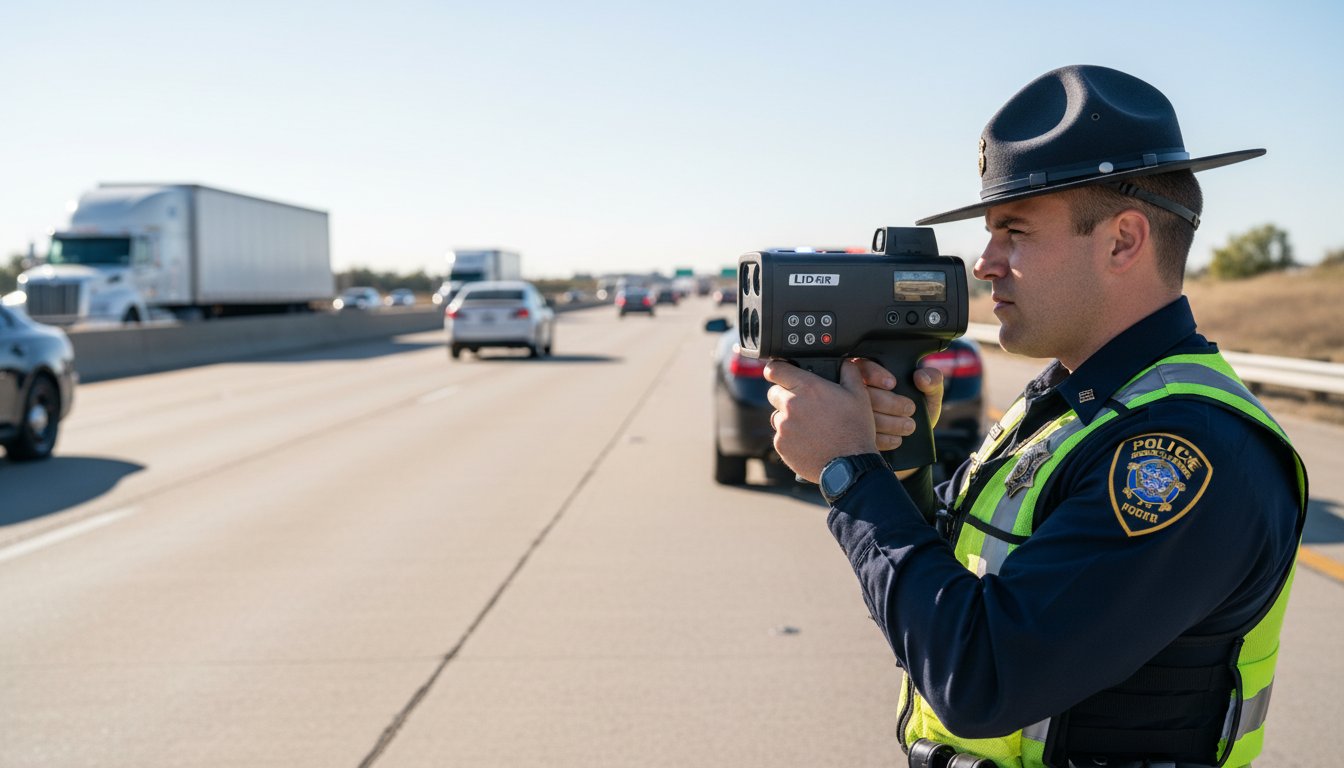
That split-second moment on the highway: an officer on the shoulder, a strange-looking device aimed your way. Is it old-school radar, or the instant-on threat of police LIDAR? For the driver who refuses to compromise, ignorance is not an option. A fleeting glimpse of a police lidar gun side view is often the only warning you get before a ticket is printed-a ticket your radar detector was powerless to prevent. This technology is the single biggest threat to your driving record, designed to be surgically precise and virtually undetectable by conventional countermeasures.
This guide is your tactical advantage. We are pulling back the curtain to give you an insider’s look at the components and operation of these legendary enforcement tools. You will learn to visually identify any police laser gun in the field, understand the exact process officers use to target your vehicle, and most critically, discover the inherent weaknesses in LIDAR technology. It’s time to move from being a target to being in control. Prepare to arm yourself with the ultimate knowledge needed to secure total protection against the most advanced speed traps on the road.
Anatomy of a Police LIDAR Gun: A Component Breakdown
At first glance, a modern police LIDAR gun looks like a futuristic pair of binoculars or a high-tech camcorder. Make no mistake: this is not a consumer device. It is a highly focused, purpose-built piece of optical equipment. Every button, lens, and contour seen in a police lidar gun side view is engineered for one ultimate purpose: instant, undeniable speed acquisition. This is a precision instrument designed to give law enforcement a decisive advantage.
To fully grasp the operational perspective and design of this technology, examine this video:
Optics: The Eyes of the System
The core of any LIDAR unit is its dual-aperture optical system. One lens acts as the transmitter, firing hundreds of invisible infrared laser pulses per second in an exceptionally narrow beam. The second, larger lens is the receiver, tasked with capturing the faint reflections of those pulses as they bounce off the target vehicle. The system’s legendary accuracy depends entirely on the quality and alignment of these powerful optics.
HUD and Viewfinder: What the Officer Sees
Looking through the viewfinder, the officer isn’t just aiming; they are interfacing with a sophisticated Heads-Up Display (HUD). A red aiming dot allows for pinpoint targeting of a specific vehicle, even in dense traffic. The principles of LIDAR traffic enforcement rely on this instant feedback loop, where the HUD displays critical data in real-time, including the target’s speed, its exact distance (range), and confirmation indicators for a successful measurement lock.
Controls and Trigger Mechanism
The primary interface is the trigger, which initiates the laser firing sequence. Surrounding it are other essential controls, often for toggling settings like range priority, activating adverse weather modes that filter out rain or fog, and logging violation data. The entire unit is ergonomically designed for stable, handheld operation. The grip and balance are optimized to help an officer hold the unit steady, aim precisely, and acquire a speed in under a second-a critical factor in modern speed enforcement.
Operation: How Police Target Your Vehicle with LIDAR
Unlike the wide, indiscriminate beam of police radar, LIDAR is a surgical instrument of speed enforcement. An officer doesn’t simply point it in the direction of traffic; they must actively hunt and target a single vehicle with extreme precision. The typical roadside setup involves an officer in a stationary position-often on an overpass or the shoulder-with a clear line of sight to approaching traffic. This provides the officer with a perfect vantage point, whether they have a head-on or police lidar gun side view of your vehicle.
The entire process, from initial targeting to speed acquisition, is executed with devastating speed. This is the critical vulnerability for drivers who rely on passive countermeasures. The pinpoint accuracy and instant-on nature of LIDAR are precisely why it’s considered such a deadly threat on the road.
Step 1: Target Acquisition and Aiming
The engagement begins when the officer raises the LIDAR gun and peers through an integrated scope or heads-up display. Through this viewfinder, they see a red aiming dot, which they must manually place on a specific part of your vehicle. For maximum effectiveness, they are trained to target flat, highly reflective surfaces. The prime targets include:
- Your front license plate
- A headlight assembly
- The vehicle’s grille
Step 2: Firing the Laser Pulses
Once the red dot is locked onto the target, the officer pulls and holds the trigger. In that instant, the LIDAR gun unleashes a barrage of hundreds of invisible, infrared laser pulses. These pulses form an extremely narrow beam-only a few feet wide at a distance of 1,000 feet-and travel toward your vehicle at the speed of light. The attack is silent, invisible, and brutally efficient.
Step 3: Calculating Speed and Range
The laser pulses strike your vehicle and are reflected back to the LIDAR gun’s receiving lens. An ultra-precise internal clock measures the “time-of-flight” for each pulse to make the round trip. Because the gun is firing a rapid succession of pulses, it can measure the change in your vehicle’s distance over that tiny fraction of a second. This method is so exact that many agencies consider it their speed enforcement weapon of choice for isolating a single car from a pack of traffic. The gun’s internal computer instantly performs the calculation (distance ÷ time) and displays your exact speed.
This entire sequence is completed in less than half a second. By the time a radar detector alerts you to the laser scatter, your speed has already been captured and recorded. It’s a “too late” warning that serves only to inform you that the game is already over.
The Most Common Police LIDAR Guns in the US
To the untrained eye, any police LIDAR gun looks the same. However, a handful of specialized manufacturers-including Laser Technology, Inc. (LTI), Stalker, and the formidable DragonEye Technology-produce these devices for law enforcement. While a police lidar gun side view might appear generic across models, their internal technology and targeting algorithms vary dramatically. Understanding this hierarchy of threats is the first step toward achieving total protection. For the driver who refuses to compromise, only a system engineered to defeat every single one of them will suffice.
The Workhorses: LTI TruSpeed and Stalker LIDAR
The vast majority of LIDAR encounters on US roads involve devices from LTI and Stalker. Models like the LTI TruSpeed series and the Stalker LIDAR are legendary for their pinpoint accuracy, rugged reliability, and user-friendly operation. These guns are the trusted standard for countless state and local police departments. They operate on a fixed, predictable pulse rate, conforming to strict NHTSA LIDAR Performance Specifications, making them a baseline threat that any serious countermeasure system must handle flawlessly.
The Apex Predator: DragonEye Technology
In the world of speed enforcement, DragonEye LIDAR guns are the apex predators. These units represent the most advanced threat a driver can face, engineered specifically to render conventional laser jammers obsolete. DragonEye’s patented Variable Pulse Rate (VPR) technology constantly alters its laser firing pattern, creating a complex and unpredictable signal that fools inferior countermeasures. Many systems that claim to offer “laser protection” will fail catastrophically against this deadly threat, giving you a false sense of security right before the ticket is written. This is where elite engineering makes the difference. See how AL Priority’s ECCM technology provides the ultimate defense, delivering legendary, proven performance against the most sophisticated LIDAR in the world.
Ultimately, whether you are targeted by a common Stalker gun or the most advanced DragonEye, the view of a police lidar gun side view aimed at your vehicle means an instant and precise speed reading. Only the #1 rated and most powerful multi-purpose laser defense system, AL Priority, has the proven technology to provide a shield against every LIDAR gun in use today.

LIDAR vs. Radar: Why Laser is a More ‘Deadly’ Threat
In the world of speed enforcement, many drivers use the terms ‘radar’ and ‘laser’ interchangeably. This is a critical, and often expensive, mistake. For the driver who refuses to compromise on protection, understanding the fundamental difference is non-negotiable. Let’s be unequivocally clear: your high-end radar detector offers zero practical protection against a modern police LIDAR gun. You are bringing the wrong tool to an entirely different fight.
The most effective analogy is this: Radar is a shotgun blast; LIDAR is a sniper shot. One sprays a wide area with radio waves, making it easy to detect. The other is a single, precise, and instantaneous strike with a beam of light.
Beam Divergence: The Critical Difference
A police radar beam spreads out significantly over distance. At 1,000 feet, its signal can be hundreds of feet wide, bouncing off everything in its path. This massive “scatter” is what gives a radar detector an advance warning. In stark contrast, a LIDAR beam is a highly focused pulse of infrared light. From the same 1,000-foot distance, its beam is only two to three feet wide-just enough to target your front license plate or headlight. This pinpoint accuracy, especially when viewed from a police lidar gun side view, means no scatter, no warning, and no escape.
Warning Time: Instant-On vs. Advance Warning
Radar units are often left transmitting continuously, allowing a detector to sniff out the ambient signal miles in advance. LIDAR technology is fundamentally different. It is an “instant-on” weapon. The gun transmits absolutely nothing until the officer targets your vehicle and pulls the trigger. The entire process-from trigger pull to speed acquisition-takes less than half a second. By the time your detector screams “Laser!”, your speed has already been captured and recorded. It’s no longer a warning; it’s a ticket notification.
The surgical precision and instant-on nature of LIDAR render traditional countermeasures obsolete. Against this threat, you don’t need a detector; you need a defense system. Only a proactive, multi-purpose laser system can offer real-time protection against a direct LIDAR attack. It’s time to even the playing field. Learn more about the ultimate defense at alpriorityusa.com.
The Achilles’ Heel: Exploiting LIDAR’s Weaknesses
Police LIDAR is a deadly threat to your driving record, prized for its surgical precision and instant-on capability. However, this advanced technology is not infallible. For the discerning driver who understands the system, its operational requirements create exploitable weaknesses. Unlike passive radar detection, which merely alerts you to a threat often too late, defeating police laser requires an aggressive, active defense. This is where a true laser jammer becomes non-negotiable for ultimate protection.
Operational & Environmental Limitations
A LIDAR gun’s effectiveness is constrained by physics and procedure. An officer cannot simply “point and shoot” under any condition. These limitations are your first line of defense:
- Stationary Operation: LIDAR requires an extremely stable platform to aim its narrow beam. It cannot be used effectively from a moving patrol car, forcing officers to target from a fixed, predictable position.
- Clear Line of Sight: The laser beam cannot pass through solid objects. Any obstruction-another car, a guardrail, or even a bridge support-can block the signal. An officer’s ability to target your vehicle from a police lidar gun side view is entirely dependent on this unobstructed path.
- Weather Degradation: The infrared light pulses are susceptible to atmospheric interference. Heavy rain, dense fog, or falling snow can disperse the beam, making it impossible for the gun to receive a coherent return signal and calculate your speed.
The Only True Countermeasure: Laser Jamming
A radar detector is useless against a LIDAR gun; by the time it alerts you, the officer already has your speed. To defeat laser, you must prevent the gun from getting a reading in the first place. This requires an active countermeasure system-a laser jammer.
Unlike passive detectors, a laser jammer is an offensive system. When its sensors detect the incoming pulses from a LIDAR gun, it instantly fires back its own proprietary sequence of light pulses. This powerful response overwhelms the police gun’s computer, preventing it from calculating a speed. This critical process provides you with several seconds of protection-invaluable time to check your speed, adjust accordingly, and then deactivate the system. You remain in complete control.
For the driver that refuses to compromise, there is no substitute for legendary performance. Don’t leave your protection to chance. Equip your vehicle with the #1 rated AL Priority system and render any police lidar gun side view or frontal shot completely ineffective. It’s time to even the playing field.
Gain the Ultimate Advantage Over Police LIDAR
Understanding modern speed enforcement is your first line of defense. As we’ve detailed, police LIDAR is a precise and formidable threat, targeting vehicles with a pinpoint laser beam that leaves drivers with zero reaction time. Recognizing a police lidar gun side view is often too late. While knowing its operational weaknesses provides a theoretical edge, true protection requires a technological countermeasure that is just as sophisticated and powerful.
This is where legendary performance meets cutting-edge innovation. AL Priority is engineered for the driver who demands the absolute best. As the #1 Rated Laser Jammer in independent testing and the first system to defeat the formidable DragonEye VPR technology, its superiority is undisputed. Better yet, it operates as a multi-purpose system, providing 100% legal parking sensor functionality for complete peace of mind. Refuse to compromise. Get the ultimate protection with an AL Priority system.
It’s time to even the playing field. Drive with the confidence that only the world’s leading laser defense can provide.
Frequently Asked Questions About Police LIDAR
How accurate are police LIDAR guns?
Police LIDAR guns are surgically precise and represent a deadly threat to your driving record. Unlike radar, which uses a wide-beam signal, LIDAR targets a specific point on your vehicle with a narrow beam of infrared light, often measuring speed in less than half a second. This technology is accurate to within +/- 1 MPH, leaving absolutely no margin for error. This pinpoint accuracy is precisely why a passive detector is obsolete; only an active countermeasure system provides true protection.
What is the maximum range of a police laser gun?
Most police LIDAR guns have an effective operational range of 2,000 to 4,000 feet, allowing officers to target vehicles long before a driver can react. However, leading-edge systems like the DragonEye can achieve accurate readings from well over 5,000 feet under ideal conditions. This extreme range capability makes early detection impossible for passive devices and underscores the necessity of a powerful, proactive laser defense system to level the playing field against long-range enforcement tactics.
Can a police LIDAR gun be used at night?
Absolutely. Police LIDAR operates using a beam of infrared light, which is invisible to the human eye and completely unaffected by darkness. Nighttime operation is just as effective-and often easier for the officer due to reduced traffic, allowing for cleaner, more isolated targeting. This 24/7 operational capability means there is no “safe” time to be unprotected. The threat is constant, demanding a defense system that is always ready to perform, day or night.
Do LIDAR guns take photos or videos of the vehicle?
While basic LIDAR guns only record speed, advanced enforcement systems like the DragonEye LidarCam integrate high-resolution cameras to capture photographic and video evidence of the infraction. This provides undeniable proof, including a clear shot of your vehicle, speed, and location, making any ticket virtually impossible to contest. When an officer has a police lidar gun side view with video evidence, your only winning move is to have prevented the speed reading from ever being taken.
Is there any way to tell if you are being targeted by laser?
Without a dedicated laser defense system, it is impossible. The LIDAR beam is infrared, invisible, and obtains a speed reading in a fraction of a second-often under 300 milliseconds. A simple laser detector on a radar detector will only alert you *after* your speed has been recorded, serving as little more than a ticket notifier. The only true way to know you’re being targeted in time to react is with a system that provides instant alerts and active countermeasures.
Why does my radar detector have a laser sensor if it doesn’t work?
The laser sensor on a radar detector is a marketing feature that offers a false sense of security. It can technically detect a laser beam, but by the time it alerts, your speed has already been captured. Given the pinpoint nature of a police lidar gun side view targeting, the beam must hit the detector directly, which is highly unlikely. This “ticket notification” feature is fundamentally useless for actual protection. For true defense, you need a dedicated, multi-sensor laser countermeasure system.
Leave a Reply